Impact of Advertising Bans on Sweepstakes Casino Acquisition
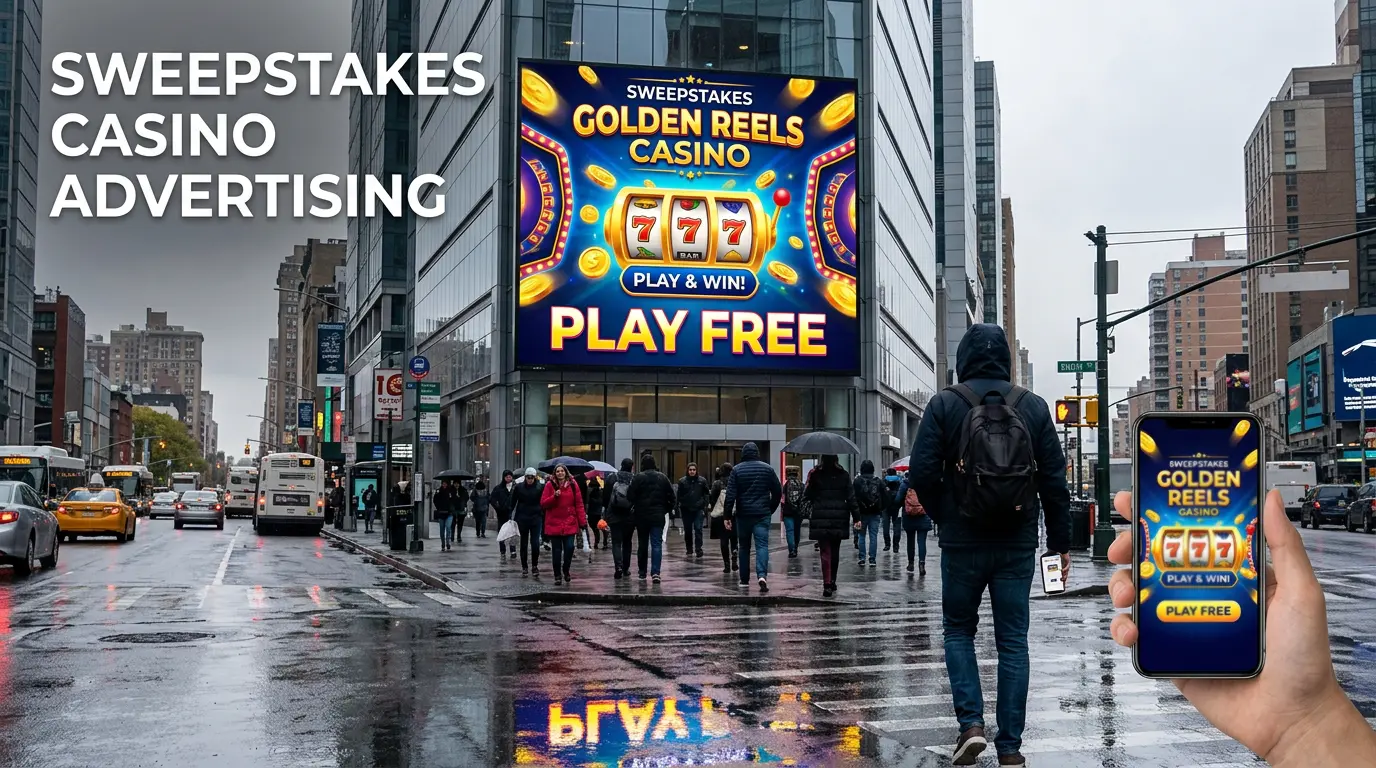
By early 2025, sweepstakes casinos accounted for roughly 50% of all online casino advertising seen by US consumers, according to data analyzed by Sensor Tower for the American Gaming Association. Half of every casino ad impression in the country came from operators who weren’t licensed as casinos at all. The ad machine behind free-to-play had grown so dominant that it threatened to drown out the marketing of legally regulated operators — and regulators, platforms, and lawmakers noticed.
Then, on October 28, 2025, Google banned sweepstakes casino advertising across all its platforms. The single largest digital advertising channel for the industry went dark overnight. What followed reshaped how players discover platforms, how operators acquire customers, and how the marketing landscape is likely to evolve in 2026 and beyond.
How Sweepstakes Ads Came to Dominate Casino Marketing
The advertising dominance of sweepstakes casinos wasn’t accidental — it was a structural advantage. Licensed online casinos can only advertise in the seven states where iGaming is legal. Sweepstakes casinos, operating under the theory that they’re not gambling, advertised nationally across 45-plus states. That asymmetry produced a lopsided ad landscape where unlicensed operators outspent licensed ones simply by reaching a larger audience.
VGW led the charge. With over $6 billion in revenue and roughly $300 million in advertising spend, VGW funded celebrity endorsements from high-profile figures and broadcast campaigns that gave sweepstakes casinos mainstream visibility. VGW’s market share — once exceeding 90% — has since fallen to roughly 50% as competitors entered, but its advertising investment established the template. Other operators followed VGW’s playbook at smaller scales, pouring money into social media campaigns, influencer partnerships, and affiliate programs.
The affiliate channel deserves particular attention. Review sites, bonus comparison platforms, and YouTube creators earned commissions for every player they referred — typically $50 to $100 per signup. This created an entire ecosystem of content dedicated to promoting sweepstakes casinos, much of it designed to rank in search results for queries like “free sweeps coins” and “no deposit bonus.” The organic search landscape filled with affiliate-driven content, making it increasingly difficult for players to distinguish independent information from paid promotion.
Social media advertising — particularly on Facebook and Instagram — became the second-largest channel after Google. Sweepstakes casinos ran targeted campaigns aimed at demographics most likely to convert: adults aged 25 to 54, interest-targeted by gaming, casino, and entertainment categories. The targeting precision available on these platforms meant that sweepstakes casino ads reached people who had already demonstrated interest in gambling-adjacent content — creating a pipeline that felt organic to the user but was meticulously engineered by the advertiser.
The result was an advertising saturation that drew complaints from licensed operators, responsible gaming advocates, and consumer protection groups alike. The AGA repeatedly cited the advertising disparity as evidence that sweepstakes casinos had an unfair competitive advantage — marketing the experience of gambling without bearing the costs of licensing, regulation, or responsible gaming mandates that licensed operators fund.
The Google Ad Ban — What Changed and What Didn’t
On October 28, 2025, Google updated its Gambling and Games advertising policy to exclude sweepstakes casinos from the “social casino games” category that had previously allowed their ads. The policy now states explicitly: sweepstakes casinos are “not social casino games” and fall instead under the stricter online gambling rules, which require operator licensing and country-specific certification. Because most sweepstakes operators lack gambling licenses, the reclassification effectively barred them from running ads across Google Search, YouTube, and the Google Display Network.
The immediate impact was dramatic. Operators that had relied on Google Ads for player acquisition saw their primary paid traffic source disappear overnight. Smaller operators — those without established brand recognition or diversified marketing channels — were hit hardest. Larger operators like VGW, which had invested heavily in brand building through celebrity partnerships and TV advertising, absorbed the blow more effectively because their traffic didn’t depend solely on Google.
What didn’t change: organic search results. Google’s ad ban targeted paid placements, not organic listings. Sweepstakes casino websites, review sites, and affiliate content continued to appear in regular search results. The distinction matters for players — the ads that previously appeared at the top of search results disappeared, but the organic listings below them remained. In practice, this shifted discovery from paid ads (where operators controlled the messaging) to organic results (where review sites and affiliates controlled the narrative).
The ban also didn’t extend to Meta (Facebook and Instagram), TikTok, or other social media platforms — at least not immediately. Some operators redirected their Google ad budgets to these channels, intensifying competition for social media ad inventory and driving up costs. Whether Meta and other platforms follow Google’s lead with their own restrictions remains an open question that the industry is watching closely.
For players, the practical consequence of the Google ban is that finding sweepstakes casinos now requires more intentional searching. The sponsored links that once populated the top of every relevant Google query are gone. What remains is a mix of operator websites, review sites (some independent, some affiliate-driven), and community forums. The quality of information hasn’t necessarily improved — it’s just delivered through different channels.
The ban also created a ripple effect on app store visibility. While Google didn’t simultaneously remove sweepstakes casino apps from the Play Store, the reduced advertising made those apps harder to discover organically. Players who previously found platforms through Google Ads now need to know what they’re looking for before they search — a shift that advantages established brands with name recognition and disadvantages newer operators still building awareness.
How Advertising Shapes Player Expectations
The relationship between sweepstakes casino advertising and player perception is well-documented. An AGA survey of 2,250 players conducted by Interpret in June 2025 found that 69% of sweepstakes casino users consider their activity to be gambling, and 68% cite winning real money as their primary motivation. These numbers suggest that marketing framing — “free-to-play,” “social casino,” “no purchase necessary” — hasn’t fooled the audience. Players know what they’re doing. The advertising simply provides the pathway to start.
Celebrity endorsements in particular create expectations that platforms may struggle to meet. A player attracted by a TV spot featuring a celebrity assumes a level of corporate legitimacy and consumer protection that may not exist. Licensed casinos are bound by regulatory standards; sweepstakes casinos are bound primarily by their own terms of service. The gap between the advertised experience and the regulatory reality is a persistent source of player frustration — and a recurring theme in the 100-plus class-action lawsuits filed against operators.
The post-Google-ban landscape has one potential silver lining for players: less advertising noise means more opportunities for informed decision-making. When every search result started with three or four paid ads from operators competing on headline bonus numbers, the loudest voice won attention regardless of quality. Without those paid placements, players are more likely to encounter review content, community discussions, and comparison tools that provide context beyond the marketing pitch.
Whether players take advantage of that shift — or simply find the same operators through different channels — will shape how the industry’s next chapter unfolds. The ad machine behind free-to-play hasn’t stopped running. It’s just been forced to find new roads after the biggest highway was closed.