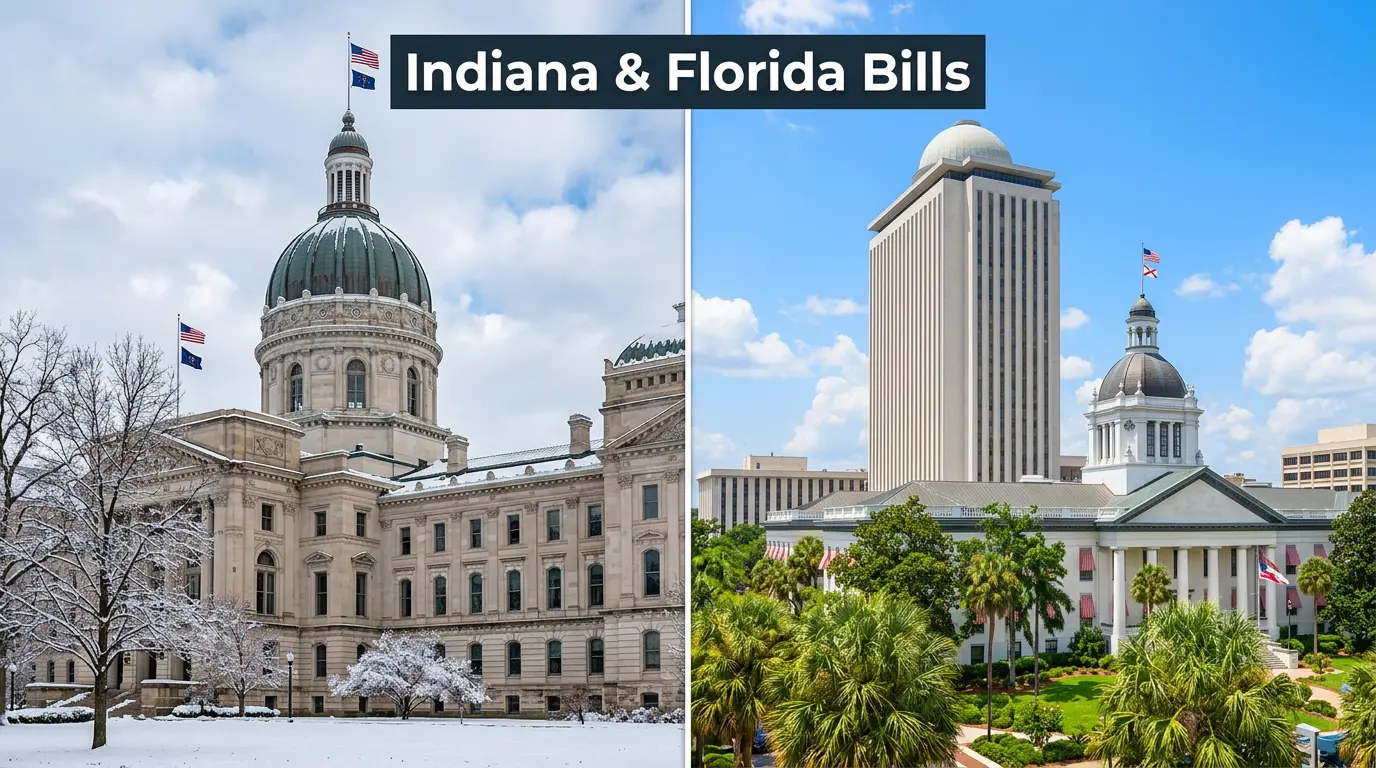
Tracking Sweepstakes Bans in Indiana (HB 1052) & Florida (HB 591)
Six states banned sweepstakes casinos in 2025. The legislative pipeline for 2026 is even broader — nine states are considering restrictions during the current session, according to reporting from Sweepsy. Among them, Indiana and Florida have drawn the most attention. Indiana’s HB 1052 has already passed both chambers and awaits the governor’s signature. Florida’s HB 591 proposes classifying sweepstakes casino operations as a felony and is working its way through the legislative process. Two bills that could shrink the map further — and the details of each reveal how different states approach the same fundamental problem through very different legal mechanisms.
Indiana’s HB 1052 passed the full House with an overwhelming 87-to-11 margin and then cleared the Senate 37-to-8 before heading to Governor Mike Braun’s desk. Florida’s HB 591 proposes classifying sweepstakes casino operations as a felony. Both bills would impose severe penalties on operators, and both target markets worth hundreds of millions in annual revenue to the sweepstakes casino industry.
Indiana HB 1052 — Passed Both Chambers, Awaiting Governor’s Signature
Indiana’s House Bill 1052 passed the Indiana House of Representatives by a vote of 87 to 11 in early February 2026, then cleared the Senate 37-to-8 before a conference committee reconciled both versions. Both chambers adopted the final conference report on February 26, 2026, sending the bill to Governor Mike Braun’s desk. If signed — or if Braun takes no action within seven days — the ban takes effect July 1, 2026, making Indiana the seventh state to formally prohibit sweepstakes casinos. The bill empowers the Indiana Gaming Commission to enforce the ban and impose fines of up to $100,000 per violation.
Nate Friend, Chairman of the Indiana Gaming Commission, provided the legislative context during testimony before the House Public Policy Committee. “There are nine states tackling this issue in this legislative session,” Friend told lawmakers (Sweepsy), listing Indiana alongside Maine, Arkansas, Maryland, Mississippi, Florida, Illinois, Ohio, and Massachusetts. That framing positioned Indiana not as an outlier but as part of a national trend — a coordinated regulatory response to an industry that had grown faster than the legal framework could accommodate.
The bill’s structure targets operators rather than individual players. It prohibits any entity from offering sweepstakes casino games to Indiana residents, defines the dual-currency model as falling within the state’s gambling statutes, and establishes an enforcement mechanism through the Gaming Commission. Players are not subject to criminal penalties for past participation, but their accounts at sweepstakes platforms would be blocked if the bill becomes law.
The $100,000 fine per violation is significant but not the bill’s strongest enforcement tool. The Indiana Gaming Commission’s authority to issue cease-and-desist orders — backed by the state AG’s power to seek injunctive relief — creates a mechanism for rapid enforcement without requiring individual prosecutions. Operators who defy a cease-and-desist order face escalating penalties and potential contempt proceedings.
The bill’s journey through the Senate confirmed the political consensus. Despite some senators — including Ron Alting (R) — expressing interest in regulating and taxing sweepstakes casinos rather than banning them outright, the 37-8 Senate vote demonstrated that prohibition had broad support. Indiana’s licensed gambling industry — including several commercial casinos and an established sports betting market — lobbied actively for the ban, arguing that sweepstakes casinos compete unfairly by avoiding the licensing fees and tax obligations that fund state programs. With the bill now on the governor’s desk, Indiana is poised to become the seventh state to enact a formal sweepstakes casino ban and the first to do so in 2026.
Florida HB 591 — A Felony Charge for Sweepstakes Operations
Florida’s approach is more aggressive than Indiana’s. House Bill 591 — an 86-page piece of legislation — proposes classifying the operation of internet gambling, including sweepstakes casinos, as a third-degree felony. The distinction between Indiana’s civil-penalty framework and Florida’s criminal-penalty framework reflects the severity with which Florida’s legislature views the issue.
The financial stakes for the industry are enormous. According to SGLA-commissioned research by Eilers & Krejcik Gaming, Florida represents approximately 8.5% of sweepstakes operator revenue — translating to over $1 billion in annual gold coin purchases. Losing Florida would compound the revenue losses already inflicted by the six 2025 bans and accelerate the market contraction that EKG’s 2026 forecasts anticipate.
Florida’s gambling landscape is uniquely complex. The state’s gaming compact with the Seminole Tribe grants the tribe exclusive rights to certain forms of gambling, and the compact’s terms have been the subject of federal litigation. Sweepstakes casinos, by operating outside the compact framework, threatened both the state’s tax revenue from licensed gambling and the Seminole Tribe’s exclusivity agreement. The alignment of tribal interests, commercial gambling operators, and state revenue officials created a powerful coalition behind HB 591.
The felony classification would make Florida one of the harshest states for sweepstakes casino enforcement. Operators serving Florida residents after the law takes effect would face criminal prosecution, not just civil fines. The practical effect would be immediate compliance — no legitimate operator would risk criminal liability to maintain access to a single state’s market, regardless of its revenue contribution. For players, the implication is clear: if HB 591 passes, Florida access will end abruptly, mirroring the shutdowns that California and New York players experienced in 2025.
What Indiana and Florida Players Should Monitor
If you’re in Indiana or Florida, the legislative timeline is the variable that determines your continued access to sweepstakes casinos. Indiana’s bill has passed both chambers and sits on the governor’s desk — if signed or allowed to become law, the ban takes effect July 1, 2026. Florida’s HB 591 is still working through the legislative process, with the 2026 session beginning in March. Neither bill has been signed into law as of early March 2026, but the momentum in Indiana points strongly toward enactment, while Florida’s outcome remains less certain.
The practical advice mirrors what applied to California and New York players before their bans took effect: redeem any accumulated SC balance sooner rather than later. If either bill becomes law, platforms will block access to residents of that state, and any unredeemed balance may be subject to a compressed compliance window. Players who wait until the last moment risk encountering the same customer support bottlenecks that California and New York players experienced in late 2025.
Stay informed through official legislative tracking tools. Indiana’s bill status is available through the Indiana General Assembly website; Florida’s through the Florida Legislature’s bill tracking system. These sources provide real-time updates on committee votes, floor votes, and gubernatorial action — information that’s more reliable than the speculation you’ll find on gaming forums and social media.
Both states represent significant markets that have delivered substantial revenue to sweepstakes operators for years. Losing access to either — or both — would represent not just a personal inconvenience but a further contraction of the national market that has already been reshaped by the 2025 bans. Players in other pipeline states (Maine, Arkansas, Maryland, Mississippi, Illinois, Ohio, Massachusetts) should watch Indiana and Florida as bellwethers: if both bills pass, the legislative momentum for bans in the remaining pipeline states becomes considerably harder to resist.