Baltimore Municipal Lawsuits Against Sweepstakes Operators
The legal pressure on sweepstakes casinos has come from state legislatures, class-action plaintiffs, and state attorneys general. In March 2026, a new front expanded: municipal enforcement. The City of Baltimore filed a civil lawsuit against six sweepstakes casino operators, becoming the second US city to take direct legal action against the industry — following the Los Angeles City Attorney’s suit against Stake.us and over 20 related defendants in August 2025. When cities fight back, the enforcement landscape fundamentally changes.
Until Baltimore’s suit, sweepstakes casino enforcement operated primarily at two levels: state-level legislative bans and private class-action lawsuits. More than 100 class-action suits had been filed by November 2025, and six states enacted legislative bans throughout the year. The LA City Attorney’s August 2025 suit against Stake.us introduced a third level — city government using its own legal authority to challenge operators on behalf of its residents. Baltimore’s action expanded that template to the East Coast. If municipal suits produce favorable outcomes, the model could multiply the enforcement pressure on an industry already under siege from state legislatures and private plaintiffs.
The Lawsuit — Who’s Named and What’s Alleged
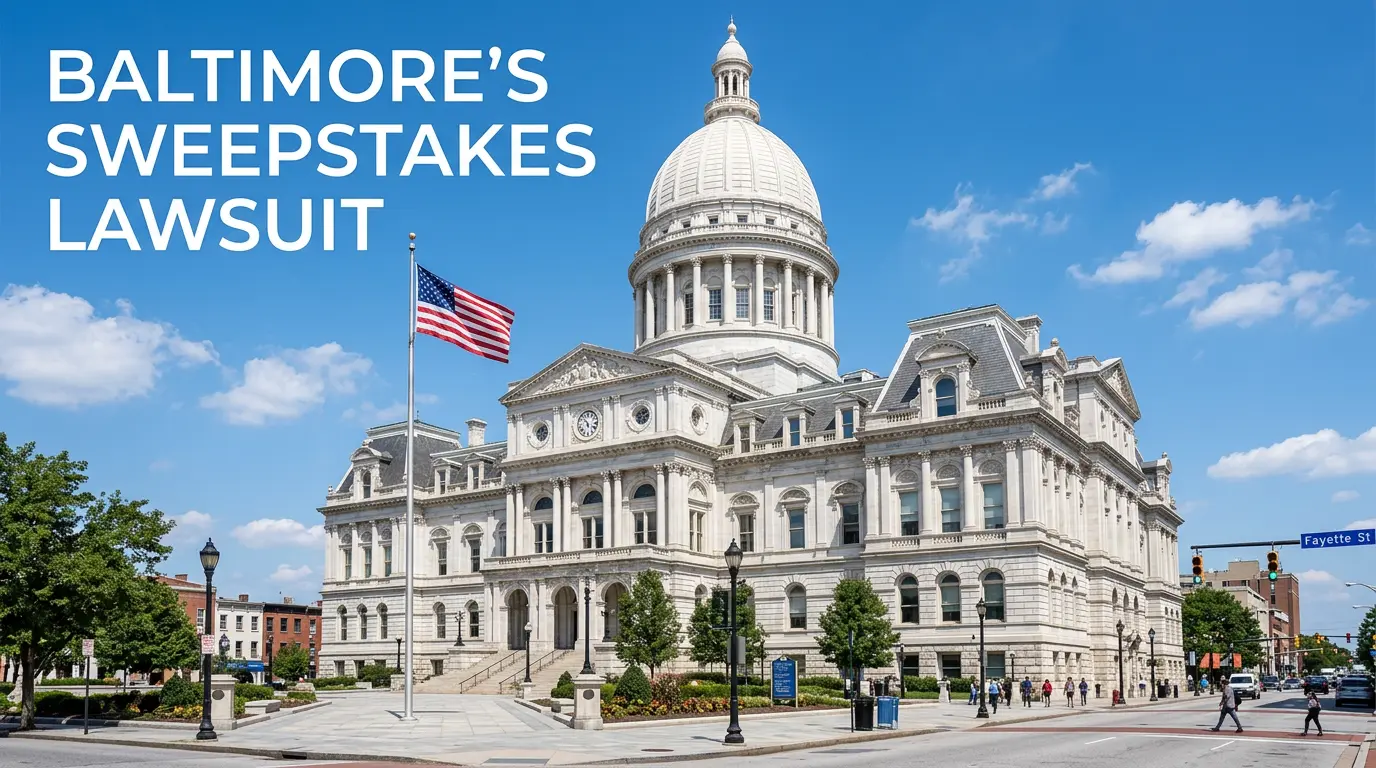
Baltimore’s suit, filed March 4 in the Circuit Court for Baltimore City, named six sweepstakes casino operators: VGW Holdings (Chumba Casino and LuckyLand Slots), B2Services (McLuck), Yellow Social Interactive (Pulsz), Sweepsteaks Limited (Stake.us), High 5 Entertainment (High 5 Casino), and Blazesoft (Fortune Coins). The complaint alleges that their platforms constitute illegal gambling under Maryland law and that their marketing practices target vulnerable communities, including young people. Mayor Brandon Scott framed the city’s action in stark terms, stating that these companies are targeting communities, including young people and minors, and profiting while ignoring the law.
The legal theory underpinning Baltimore’s suit differs from typical class-action claims. Private plaintiffs generally seek recovery of their gambling losses. Baltimore is pursuing broader relief: injunctive orders to cease operations within the city, disgorgement of profits derived from Baltimore residents, and civil penalties under consumer protection statutes. The city is acting as a plaintiff representing the public interest, not as a proxy for individual player claims.
The allegations extend beyond the standard “this is illegal gambling” framework. Baltimore’s complaint emphasizes the community impact of sweepstakes casinos — their disproportionate marketing presence in lower-income neighborhoods, the absence of responsible gaming tools mandated for licensed operators, and the deliberate use of advertising channels that reach underage audiences. The enforcement escalation is real: over 100 cease-and-desist orders were sent to operators by state regulators in 2025, and cities are now adding their own legal weight to the campaign.
The six named operators represent a cross-section of the industry — not exclusively the largest platforms, but a mix of established and mid-tier operators that Baltimore’s legal team identified as actively serving the city’s population. The specific selection suggests that Baltimore conducted its own investigation into which platforms marketed to and accepted players from within city limits, building a factual record before filing. That investigative groundwork strengthens the city’s position if the case proceeds to discovery, where operators would be required to produce data on their Baltimore-based user activity, advertising spend targeting the city’s population, and revenue generated from local players.
Could Other Cities Follow Baltimore’s Lead?
Baltimore’s suit is significant because it builds on the template established by LA’s 2025 action. If either case produces a favorable outcome — a settlement, a consent decree, or a judgment — other cities with similar demographics and concerns could replicate the approach. The legal infrastructure required to file a municipal suit against sweepstakes operators is modest compared to state-level legislation, and it doesn’t require the political consensus needed to pass a new law.
Cities with active gaming reform movements, consumer protection priorities, or elected officials who have publicly criticized sweepstakes casinos are the most likely candidates to follow Baltimore’s example. Urban centers where sweepstakes casino advertising was particularly aggressive before the Google ad ban — and where that advertising targeted specific demographic groups — have both the motivation and the evidentiary basis for similar suits. The legal costs are manageable for a city government, and the political upside of protecting residents from unregulated gambling is considerable.
Maryland’s state-level posture adds context. Maryland is among the nine states considering sweepstakes casino restrictions in the 2025-2026 legislative session, but no state-level ban has been enacted yet. Baltimore’s suit represents a city unwilling to wait for state action — a dynamic that could repeat in other states where legislative progress has been slow. Cities in Florida, Illinois, and Ohio — all pipeline states where bans are under consideration but not yet enacted — might pursue municipal enforcement as a faster alternative to the legislative process.
The industry’s response to Baltimore’s suit will be closely watched. If operators settle quickly and agree to exit the city, it signals that municipal enforcement is an effective deterrent — and that the cost of fighting a single city’s lawsuit isn’t worth the revenue from that market. If operators fight the suit and prevail, it may discourage other cities from following. If operators fight and lose, the template becomes a proven legal weapon that any city attorney can deploy. The legal outcome will shape a new dimension of sweepstakes casino regulation that didn’t exist before March 2026.
What Municipal Lawsuits Mean for Players
For players, municipal enforcement adds another layer of uncertainty to the already complicated question of where sweepstakes casinos can legally operate. State-level bans are binary — the platform either operates in your state or it doesn’t. Municipal suits introduce the possibility that access could vary by city within the same state. A sweepstakes casino might be accessible in rural Maryland but subject to a court order in Baltimore.
In practice, operators are unlikely to implement city-level geofencing. If a court orders a platform to stop serving Baltimore residents, the operator will more likely exit Maryland entirely rather than build technical infrastructure to block specific zip codes. The practical effect for Maryland players outside Baltimore could be collateral restriction — losing access not because of a state ban but because a city-level suit made the entire state economically unviable for the operator.
The broader implication is that the legal environment for sweepstakes casinos is becoming more fragmented and less predictable. State bans, pending bills, class actions, cease-and-desist orders, and now municipal suits create a patchwork of restrictions that can change at any level of government, at any time. Players who treat their sweepstakes casino access as permanent are making an assumption that the legal record doesn’t support.
The safest approach remains the same: redeem regularly, keep records, and stay informed about legal developments in your jurisdiction. Municipal lawsuits add a new variable to the equation, but the player-level response doesn’t change. Protect the value you’ve earned by converting it to cash before the next enforcement action — wherever it comes from — converts your SC balance into a customer support ticket you’ll wish you’d never had to file.