- 2026 US Sweepstakes Casino Legal Status & State Bans
- States That Banned Sweepstakes Casinos in 2025
- Nine States Considering Bans in the 2025–2026 Session
- Cease-and-Desist Orders and Enforcement Actions
- Where Sweepstakes Casinos Remain Fully Available
- Regulatory Outlook — What Players Should Watch in 2026
2026 US Sweepstakes Casino Legal Status & State Bans
In early 2024, sweepstakes casinos operated in virtually every US state with minimal regulatory interference. Washington and Idaho had restrictions on the books, and a handful of other states made vague noises about enforcement, but the prevailing assumption — among operators and players alike — was that the sweepstakes model occupied a legal gray area too obscure for legislators to bother with.
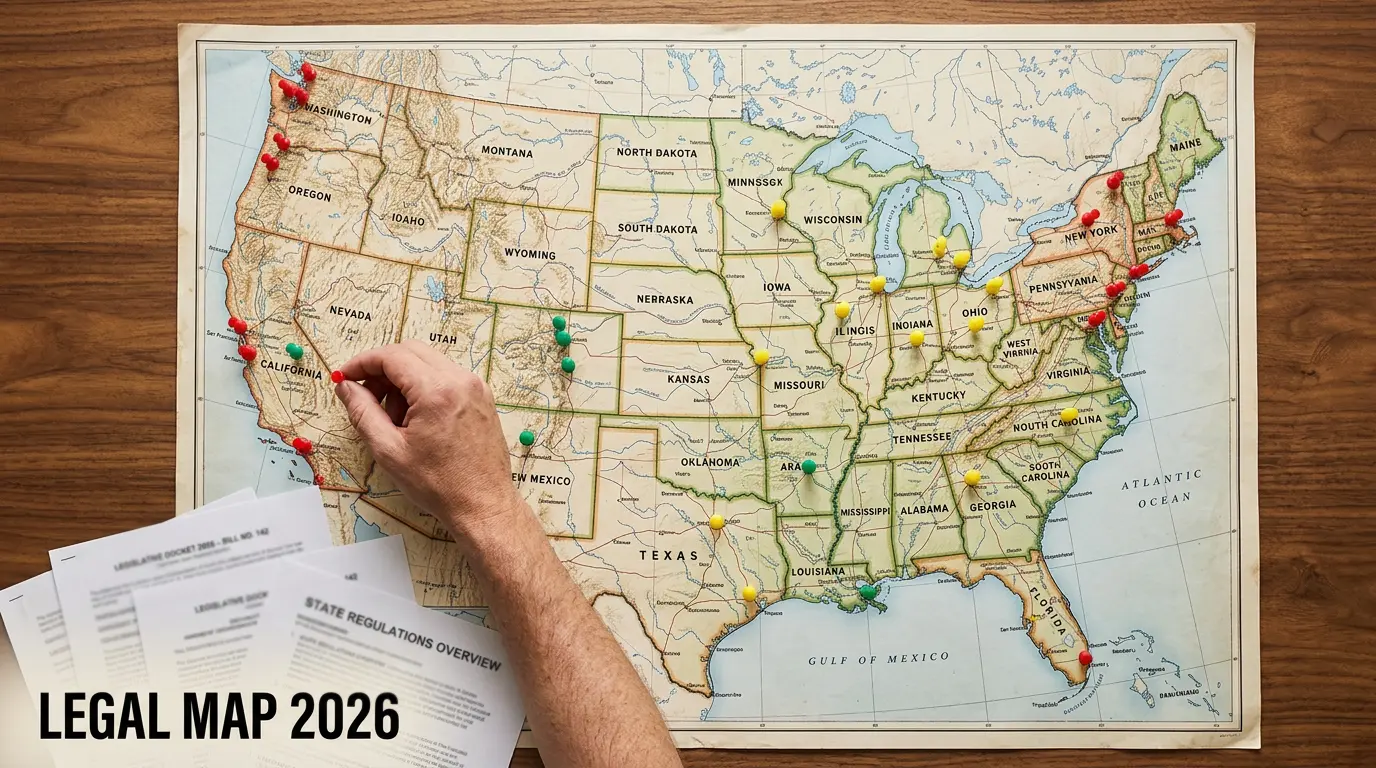
That assumption aged badly. By the end of 2025, six states had enacted explicit legislative bans on sweepstakes casino operations: California, New York, Connecticut, Montana, New Jersey, and Nevada. Not cease-and-desist letters. Not attorney general opinions. Signed laws with enforcement mechanisms and penalties attached. The regulatory map is shifting fast, and the pace shows no sign of slowing.
As of early 2026, nine additional states are considering or actively advancing their own prohibitive legislation: Indiana, Maine, Arkansas, Maryland, Mississippi, Florida, Illinois, Ohio, and Massachusetts. Some of these bills have already cleared committee votes. Others are still in early hearings. But the direction of travel is unmistakable — the window of broad, unregulated access that defined the sweepstakes casino market from 2020 through 2024 is closing, state by state, session by session.
This article tracks every ban, every pending bill, and every enforcement action that affects where you can and cannot play sweepstakes casino games in 2026. No speculation, no lobbying — just the legislative record and what it means for your account.
States That Banned Sweepstakes Casinos in 2025
Six states moved from ambiguity to prohibition in 2025. Each ban followed a different legislative path, but they share a common motivation: established gambling interests — commercial casinos, state lotteries, tribal gaming operators — argued that sweepstakes casinos were siphoning revenue without paying taxes or submitting to regulatory oversight. That argument proved persuasive in every statehouse where it was made.
California — AB 831
California’s ban is the most consequential in terms of market impact. The state accounts for roughly 20% of total sweepstakes casino sales nationally, making it the single largest market by volume. Governor Newsom signed AB 831 on October 11, 2025, classifying sweepstakes casino operations as illegal gambling under state law. The bill moved through the legislature with strong support from both the tribal gaming lobby and the California Lottery Commission, which framed sweepstakes platforms as unlicensed competitors draining consumer spending away from regulated channels.
The coalition behind AB 831 was unusually broad. California’s tribal gaming interests — which operate dozens of casinos under compacts that generate billions in annual revenue — provided the financial muscle. The state lottery added institutional credibility, arguing that sweepstakes platforms were cannibalizing scratch-ticket and draw-game revenue. Card rooms and horse racing interests piled on. Against that combined lobbying force, the sweepstakes industry’s Washington-based advocacy groups had little leverage in Sacramento.
For players, the practical effect was immediate. Major platforms like Chumba Casino, Stake.us, and McLuck geo-blocked California IP addresses within days of the signing. Players with pending redemptions reported delayed processing as operators scrambled to comply with the new law’s enforcement timeline. AMOE mail-in entries postmarked from California addresses were no longer accepted.
New York — S 5935
New York represented the second-largest state market for sweepstakes casinos, with estimated 2024 sales of $762 million according to research conducted by Eilers & Krejcik Gaming for the Social Gaming Leadership Alliance. S 5935 passed with bipartisan support and was motivated in part by the state’s aggressive expansion of licensed mobile sports betting and online casino gaming. Legislators argued that allowing unregulated sweepstakes platforms to coexist with a newly licensed iGaming market undermined the integrity of the regulatory framework New York had spent years building.
The timing was not coincidental. New York had just completed a multi-year process to license mobile sportsbooks and was in the early stages of authorizing online casino gaming through a regulated framework. Sweepstakes casinos — which offered functionally identical products without licenses, without tax obligations, and without the responsible-gaming mandates imposed on licensed operators — were an embarrassment to the regulatory narrative. Legislators from both parties saw the ban as a necessary clean-up measure to protect the credibility of a system they had invested significant political capital in creating.
The ban took effect in stages, with operators given a 90-day compliance window to cease operations, process outstanding redemptions, and notify registered users. Several operators challenged the timeline in court but were denied injunctive relief.
Connecticut, Montana, New Jersey, and Nevada
The remaining four bans followed similar patterns, though the legislative specifics varied. Connecticut and New Jersey — both states with established regulated iGaming markets — framed their bans as consumer protection measures to preserve the integrity of existing licensing regimes. Montana’s ban was driven primarily by its brick-and-mortar gambling industry, which argued that sweepstakes platforms were diverting revenue from licensed video gambling terminal operators. Nevada’s prohibition surprised no one: the state’s gaming regulatory apparatus is the most established in the country, and sweepstakes casinos were always an awkward fit within a jurisdiction that takes licensing more seriously than most countries.
Across all six states, the rhetorical pattern was consistent. Shawn Fluharty, President of the National Council of Legislators from Gaming States and a West Virginia delegate, captured the dominant legislative sentiment at the NCLGS Winter Conference in December 2025: “This issue has brought lawmakers together that it represents illegal gambling and revenue theft in many states.” That framing — sweepstakes casinos as both a legal and fiscal problem — proved to be the most effective argument for prohibition.
The combined population of these six states exceeds 100 million people. Their removal from the addressable market represents a structural contraction that no amount of marketing spending or new-platform launches can offset in the near term.
Nine States Considering Bans in the 2025–2026 Session
The six bans that passed in 2025 opened the floodgates for the current legislative session. As Nate Friend, Chairman of the Indiana Gaming Commission, stated during House Public Policy Committee hearings on HB 1052: “Indiana is one of nine states tackling this issue during the 2025–2026 legislative session, along with Maine, Arkansas, Maryland, Mississippi, Florida, Illinois, Ohio, and Massachusetts.” That list represents a geographic and political cross-section of the country — red states, blue states, gambling-heavy states, and states with no casino industry at all.
Indiana — HB 1052
Indiana’s bill is the furthest along. HB 1052 passed the Indiana House by a vote of 87 to 11, a margin that signals overwhelming bipartisan support. The bill empowers the Indiana Gaming Commission to fine sweepstakes casino operators up to $100,000 per violation and to pursue injunctive relief against platforms that continue to accept Indiana players after the ban takes effect. The Senate is expected to take up the bill in the spring session, and observers close to the process describe passage as a near-certainty.
Indiana’s motivation is straightforward: the state operates a robust regulated casino market with 13 licensed facilities and a growing online sports betting sector. Legislators view sweepstakes casinos as a direct competitive threat to a tax-generating industry that contributes hundreds of millions annually to the state budget.
Mississippi — SB 2104
Mississippi took the most aggressive approach of any pending bill. SB 2104 proposed criminal penalties including fines of up to $100,000 and prison sentences of up to ten years for operating a sweepstakes casino targeting Mississippi residents. The bill also included asset forfeiture provisions that would allow the state to seize equipment and funds associated with sweepstakes operations. SB 2104 passed the Mississippi Senate but died in a House committee in March 2026 — a setback for proponents but not necessarily a permanent one, since the bill’s Senate passage established the political viability of harsh penalties in future sessions.
Florida — HB 591
Florida’s pending legislation carries outsized industry implications because of the state’s sheer market size. According to estimates from SGLA and Eilers & Krejcik Gaming cited by iGaming Business, Florida accounts for approximately 8.5% of total sweepstakes casino revenue, translating to over $1 billion in player purchases during 2025. HB 591 is an 86-page bill that would classify internet-based sweepstakes gaming as a third-degree felony, aligning enforcement with existing anti-gambling statutes. The bill’s complexity reflects Florida’s layered gambling regulatory environment, which must accommodate tribal compacts, pari-mutuel interests, and state lottery operations simultaneously.
The Remaining Six
Maine, Arkansas, Maryland, Illinois, Ohio, and Massachusetts have bills at various stages of committee review. Maine and Arkansas have drafted narrow prohibitions targeting the sweepstakes model specifically, defining “sweepstakes gaming” as a distinct category within their gambling codes rather than relying on existing definitions that may not clearly encompass the dual-currency model. This legislative precision is deliberate — it addresses the argument that sweepstakes operators have used to avoid enforcement in other states, namely that their product does not meet the traditional legal definition of gambling.
Maryland’s approach is broader, folding sweepstakes regulation into a general update of its gambling code that also addresses daily fantasy sports and skill-based gaming machines. The sweepstakes provision is one section within a larger overhaul, which gives it political cover but also makes it vulnerable to legislative horse-trading — it could be dropped as part of a compromise without the overall bill failing.
Illinois and Ohio — both states with expanding regulated iGaming markets — are using the same competitive-integrity argument that proved effective in New York and New Jersey. Their bills explicitly cite lost tax revenue and the absence of licensing requirements as justifications for prohibition. Both states have strong commercial casino lobbies with established relationships in their respective statehouses, which gives the bills institutional backing that grassroots efforts would lack.
Massachusetts has introduced a study commission approach, stopping short of an immediate ban but signaling legislative intent to act on findings. This is the slowest path to prohibition — commissions typically take 12 to 18 months to deliver recommendations — but it also creates the most durable legal foundation if the commission ultimately recommends a ban. Massachusetts used a similar process when legalizing commercial casinos in 2011, so the model has state-specific precedent.
Not all nine bills will pass. Legislative sessions expire, priorities shift, and lobbying from the sweepstakes industry — particularly through the newly formed Social Gaming Leadership Alliance — may slow or modify some proposals. But the trajectory is clear: the number of states where sweepstakes casinos can operate freely is shrinking, and each new ban strengthens the political case for the next one.
Cease-and-Desist Orders and Enforcement Actions
Legislative bans are the most visible form of regulatory pressure, but they are not the only one. Throughout 2025, state attorneys general and gaming commissions pursued a parallel enforcement strategy that received far less media coverage but created immediate operational headaches for sweepstakes operators: cease-and-desist letters.
Over 100 cease-and-desist orders were issued by state regulators in 2025, targeting sweepstakes casino platforms operating in states including Arizona, Michigan, Louisiana, and Maryland. Unlike legislation, which requires committee hearings and floor votes, cease-and-desist letters are administrative tools that regulators can deploy unilaterally. They typically demand that an operator stop accepting players from a given state within a specified timeframe, with the implied threat of injunctive action or referral to the attorney general if compliance does not follow.
The practical effect varies. Some operators respond immediately, geo-blocking the relevant state and notifying affected players. Others ignore the letters entirely, calculating that enforcement without a corresponding statute is unlikely. A few challenge the legal basis, arguing that their sweepstakes model does not fall under the state’s gambling definitions. This last approach has had mixed results — some states backed down, while others escalated to formal legal proceedings.
The enforcement landscape also includes municipal-level action, which represents a newer and less predictable threat. In March 2026, the city of Baltimore filed a civil lawsuit against six sweepstakes casino operators, alleging violations of state gambling law and consumer protection statutes. Baltimore Mayor Brandon Scott framed the suit in urgent terms, stating that “these companies are targeting our communities, including young people and minors, and profiting while ignoring the law.” Municipal suits add another layer of legal risk for operators because they can proceed independently of state-level legislative action — a city does not need to wait for its state legislature to pass a ban before pursuing enforcement under existing consumer protection laws.
For players, the cease-and-desist landscape creates an unpredictable middle ground between “fully legal” and “explicitly banned.” You might be able to register and play at a sweepstakes casino in a state that has issued a cease-and-desist, but your account status is inherently unstable. If the operator decides to comply mid-cycle, pending redemptions can be delayed or complicated. If the state escalates, the operator may freeze accounts in the affected jurisdiction with limited notice.
The volume of enforcement activity also correlates with legislative momentum. States that issued cease-and-desist letters in early 2025 were more likely to introduce prohibitive bills later in the session. Arizona, Michigan, and Louisiana — all prolific issuers of cease-and-desist orders — are widely expected to introduce formal legislation in 2026 or 2027 if current bills in other states prove enforceable.
The takeaway for players in states with active enforcement but no formal ban: your current access is not a guarantee of future access. Monitor your state’s gaming commission announcements, and consider maintaining accounts at multiple platforms so that a single geo-block does not strand your SC balance.
Where Sweepstakes Casinos Remain Fully Available
Despite the regulatory contraction, sweepstakes casinos are still accessible in the majority of US states. The pre-2025 figure of 45+ states has dropped, but the remaining open states represent a substantial market — one that still includes high-population jurisdictions like Texas, Pennsylvania, Georgia, North Carolina, and Virginia.
In these states, sweepstakes casinos operate under the same legal theory they always have: the no-purchase-necessary entry mechanism (typically the AMOE mail-in option) removes the “consideration” element from the gambling triad, placing the activity outside the scope of most state gambling statutes. Regulators in these jurisdictions have not challenged that interpretation, either because they agree with it, because they lack the political will to pursue enforcement, or because sweepstakes casinos simply have not risen to the level of legislative priority.
That last point matters more than it sounds. State legislatures operate on limited calendars with competing priorities. A sweepstakes casino ban requires someone to introduce a bill, shepherd it through committee, and secure floor votes — all while navigating lobbying pressure from both the established gambling industry (which wants bans) and the sweepstakes industry (which does not). In states without a strong brick-and-mortar casino lobby, there is less institutional pressure to act, even if individual legislators have concerns about the model.
Texas is the most notable example. The state has no commercial casino industry, no regulated online gambling, and a constitutional provision that makes expanding gambling difficult. Sweepstakes casinos operate there without significant regulatory attention — not because Texas has endorsed the model, but because no organized interest group has made banning it a priority. The same dynamic applies to large Southeastern states like Georgia and North Carolina, where gambling legislation of any kind moves slowly through socially conservative legislatures.
For players in these states, the current environment is favorable but not permanent. The 2025 ban wave demonstrated that regulatory action can move quickly when the political conditions align, and every new ban in a neighboring state increases the likelihood that your state’s legislators will take notice. The typical timeline from first hearing to signed law was six to nine months in the 2025 cycle — fast by legislative standards.
Players in states with no current restriction or pending legislation still have the widest access to no-deposit SC bonuses, AMOE mail-in programs, and full redemption capabilities. The platforms in our Tier 1 and Tier 2 rankings all operate in these jurisdictions without geo-restrictions. If you are in one of these states, the practical advice is simple: take advantage of current access, keep your KYC documents current, and pay attention to your state legislature’s gambling committee calendar. Access that feels permanent today may not survive the next legislative session.
Regulatory Outlook — What Players Should Watch in 2026
The financial projections tell the story as clearly as the legislation does. Eilers & Krejcik Gaming, the most-cited analytics firm covering the sweepstakes sector, revised its 2025 net revenue estimate downward from $4.7 billion to $4 billion due to regulatory headwinds, and projects a further 10% decline to $3.6 billion in 2026 under its base-case scenario. The bear case is steeper — a 30% contraction if additional large-population states follow California and New York’s lead before year-end.
Several events in the next six to twelve months will determine which scenario plays out. Indiana’s HB 1052 is the most immediate test. If the Senate passes the bill as expected, it will mark the first 2026 ban and almost certainly accelerate legislative action in the remaining pipeline states. Florida’s HB 591 carries even greater weight because of the state’s market size; a Florida ban alone would remove an estimated $1 billion in annual player purchases from the industry.
The industry’s response will also matter. The Social Gaming Leadership Alliance, formed in 2025 to represent sweepstakes operators collectively, has positioned itself as a partner for regulation rather than an opponent of it. Whether that messaging translates into legislative compromise — some form of licensing and taxation rather than outright prohibition — remains to be seen. A few states in the pipeline have signaled openness to regulatory frameworks that would allow sweepstakes casinos to operate under licensing requirements similar to those imposed on traditional online casinos. If even one state pursues that approach successfully, it could shift the nationwide dynamic from prohibition toward regulation.
For players, the practical advice stays the same regardless of which scenario unfolds: check your state’s status before registering at a new platform, cash out regularly rather than accumulating large SC balances, and treat every open-state window as potentially temporary. The industry that existed in 2024 — broad access, minimal oversight, no geographic restrictions — is not coming back. What replaces it is still being written, one statehouse at a time.