Comparing Sweepstakes and Real Money Casino Models
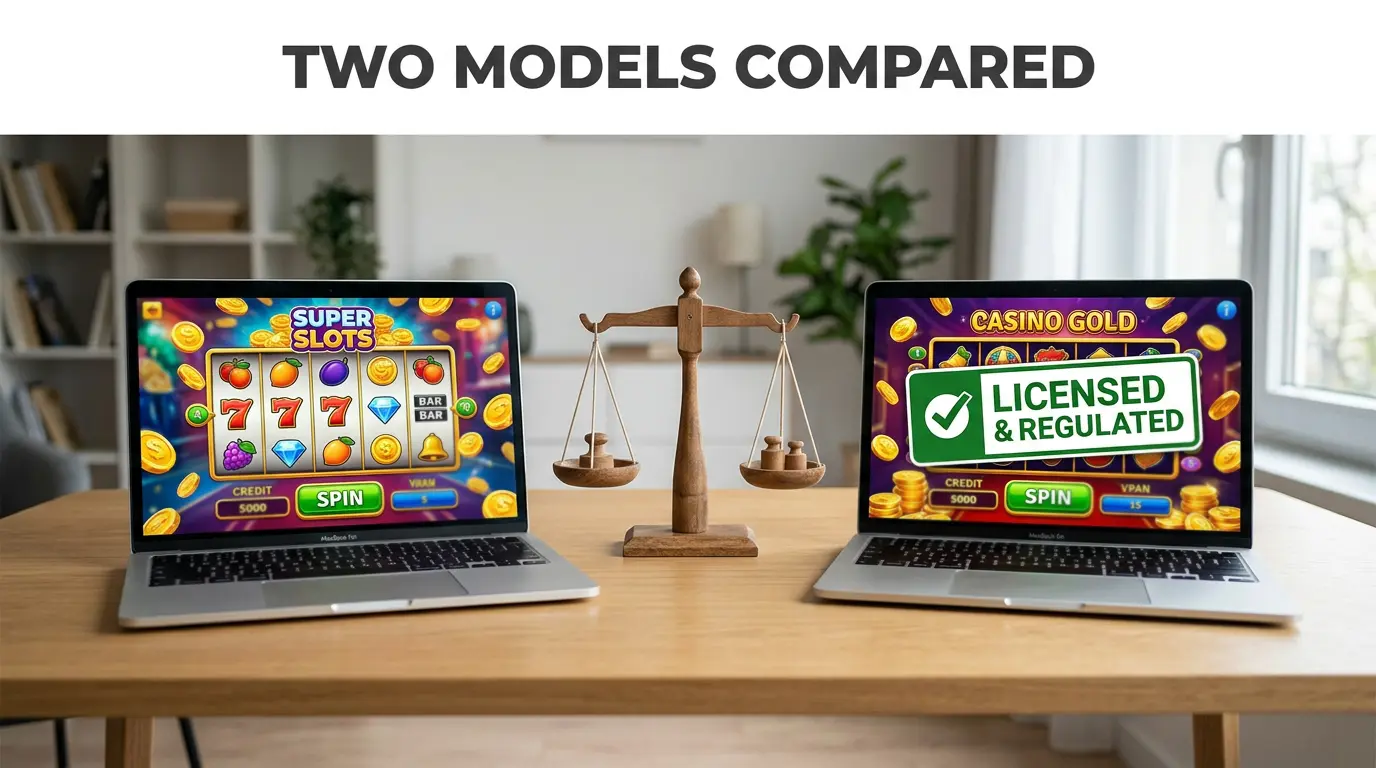
Open a sweepstakes casino and a licensed online casino side by side. Same slot themes. Same spinning reels. Same dopamine loop when three symbols line up. A player dropped into either interface without context would struggle to tell which one is regulated by a state gaming commission and which one technically isn’t gambling at all.
That visual similarity masks a structural divide that matters for your wallet, your legal exposure, and your protections as a consumer. The US commercial gaming industry generated a record $78.72 billion in gross gaming revenue in 2025 — a number that includes licensed casinos, sportsbooks, and iGaming platforms operating under state oversight. On the other side of that divide, the sweepstakes casino sector produced over $10.6 billion in gross revenue in 2024, according to data from KPMG and Eilers & Krejcik Gaming. Two industries measured in the tens of billions, serving largely overlapping audiences, governed by completely different legal frameworks.
This is the $10-billion question regulators are still answering: can two models that produce an identical player experience coexist when one pays licensing fees, submits to audits, contributes tax revenue, and follows responsible gaming mandates — and the other does none of those things?
This article compares the two models across every dimension that affects you as a player. Not to declare a winner — the right choice depends on your priorities, your state, and your tolerance for regulatory uncertainty — but to lay out the facts that the marketing departments on both sides would rather you didn’t see together in one place.
Because of this unique promotional model, you should always verify the legal sweepstakes casino states before attempting to register a new account.
Legal Framework — Licensed Operation vs the Sweepstakes Loophole
A real-money online casino in the United States operates under a state-issued license. That license comes with obligations: application fees that can run into the millions, background checks on every executive and major shareholder, annual audits of game fairness and payout ratios, mandatory responsible gaming programs, and ongoing tax payments calculated as a percentage of gross gaming revenue. In New Jersey, for example, licensed iGaming operators pay an effective tax rate of about 15% on revenue. In Pennsylvania, the rate exceeds 50%.
The aggregate fiscal impact is significant. In 2024, licensed US gambling operations contributed approximately $15.9 billion in gaming tax revenue to state and local governments — a figure that rose to $18.09 billion in 2025. That money funds education, infrastructure, and public services. It is also the single most powerful argument that the licensed industry deploys against sweepstakes competitors — because sweepstakes casinos pay none of it. Not a reduced rate. Not a negotiated share. Zero. The entire $10-billion-plus sweepstakes sector contributes nothing to the state tax base in any jurisdiction where it operates, because no jurisdiction has established a taxing mechanism for an activity that is legally classified as a promotional sweepstakes rather than gambling.
This zero-tax reality is the core grievance driving the legislative backlash that produced six state bans in 2025 and nine pending bills in 2026. For state legislators watching their licensed casino partners pay billions in taxes while a competing industry pays nothing, the inequity is not philosophical — it is fiscal.
Sweepstakes casinos operate under a different legal theory entirely. Traditional gambling law requires three elements to classify an activity as gambling: consideration (payment), chance, and prize. Sweepstakes casinos argue that they eliminate the consideration element by offering a free entry mechanism — the Alternative Method of Entry, or AMOE, typically a mail-in request for free Sweeps Coins. If no purchase is required to play and win, the argument goes, the activity is a promotional sweepstakes rather than gambling.
That argument has held up in most jurisdictions — until recently. As Dan Hartman, former Director of the Colorado Division of Gaming and now Senior Advisor at GMA Consulting, put it at the NCLGS Winter Conference: “The one thing I’ve said all along is you can’t all break in through the backdoor. Companies pay a lot to get licensed and do the things they do in our state.” The sentiment captures a growing frustration among regulators who watch sweepstakes operators offer what looks and feels like online gambling while claiming their product falls outside the regulatory perimeter.
The licensing gap creates downstream consequences that go beyond tax revenue. Licensed casinos must publish payout percentages, submit to random game audits, maintain segregated player funds, and provide self-exclusion options linked to statewide registries. Sweepstakes casinos face none of these requirements in most states. Some operators voluntarily adopt responsible gaming measures — VGW’s spending limits are one example — but voluntary adoption is not the same as regulatory mandate. There is no guarantee of consistency, no third-party enforcement, and no penalty for rolling back consumer protections if business conditions change.
For players, the legal distinction translates into a concrete difference in recourse. If a licensed casino withholds your winnings without justification, you can file a complaint with a state gaming commission that has subpoena power and enforcement authority. If a sweepstakes casino does the same thing, your options are limited to customer support, social media pressure, or civil litigation — all of which are slower, less certain, and more expensive than a regulatory complaint.
The framework difference is not a hypothetical concern. It is the foundation on which every other comparison in this article rests.
What Feels the Same — And What Doesn’t
The user interface of a sweepstakes casino is, for practical purposes, indistinguishable from a licensed online casino. You browse a game lobby. You select a slot or table game. You watch reels spin or cards dealt. You see a balance go up or down. The visual language, the sound design, the reward feedback loops — all of it is borrowed directly from the regulated gambling playbook, because most sweepstakes game providers are the same studios that supply licensed casinos.
Players notice. According to a June 2025 survey of 2,250 sweepstakes casino users conducted by the American Gaming Association, 69% of respondents described their sweepstakes activity as gambling. When asked about their primary motivation, 68% cited the chance to win real money. The industry’s legal position — that sweepstakes casinos are promotional entertainment, not gambling — is a distinction that most of its own customers do not recognize or accept.
Tres York, Vice President of Government Relations at the AGA, summarized the survey findings bluntly: “Consumers see right through the ‘sweepstakes’ casino facade and they’re calling it what it is: gambling.” That disconnect between legal classification and player perception is not just an academic problem. It shapes how people approach the product — and how much risk they are willing to take with their money.
There are real experiential differences, though they tend to be structural rather than visual. The biggest is currency. In a licensed casino, you deposit dollars and withdraw dollars. In a sweepstakes casino, you purchase Gold Coins (which have no cash value), receive bonus Sweeps Coins (which can be redeemed for cash prizes), and navigate a dual-currency system that adds a layer of abstraction between your money and your gameplay. That abstraction is by design — it is the mechanism that supports the sweepstakes legal argument — but for players it means tracking two balances, understanding which currency applies to which game, and meeting separate conditions for redemption.
Game selection also differs, though the gap is narrowing. Licensed casinos in states like New Jersey and Michigan offer thousands of titles from dozens of providers, including live dealer games streamed from regulated studios. Sweepstakes casinos have expanded rapidly but still operate with smaller catalogs and fewer live dealer options. The quality of individual games is comparable — many come from the same developers — but the variety available at any given sweepstakes platform is typically a fraction of what a fully licensed casino offers.
Customer support and dispute resolution represent another divergence. Licensed platforms must maintain complaint procedures that comply with state regulatory standards. Response times and resolution rates are tracked by gaming commissions. Sweepstakes casinos set their own customer service standards, and the quality varies dramatically: some respond within hours, others take days, and players have limited avenues for escalation beyond posting on Reddit.
Payout transparency is perhaps the least visible but most consequential difference. Licensed online casinos in states like New Jersey publish aggregate return-to-player percentages that are verified by independent testing labs and reported to regulators. Players can check whether a platform’s slot games return 95% or 90% over time and make informed decisions accordingly. Sweepstakes casinos are under no obligation to publish or verify payout data. Some individual games display theoretical RTP figures from their providers, but there is no regulatory requirement that the platform’s actual payout performance matches those numbers, and no independent body audits the results.
Money In, Money Out — How Funds Move in Each Model
In a licensed online casino, the money flow is transparent. You deposit funds via bank transfer, debit card, or approved e-wallet. Those funds appear in your account as a dollar balance. You wager those dollars on games. Winnings are credited in dollars. When you withdraw, you receive dollars. Every transaction is traceable, reportable, and subject to regulatory oversight. Operators must maintain segregated player accounts in most licensed jurisdictions, meaning your deposited funds are legally separated from the company’s operating capital.
Sweepstakes casinos route money through a more elaborate path. The entry point is a Gold Coin purchase — you buy a package of Gold Coins, which are explicitly marketed as entertainment tokens with no cash value. Bundled with that purchase, you receive bonus Sweeps Coins. It is the Sweeps Coins, not the Gold Coins, that can be redeemed for cash prizes after meeting playthrough requirements. The Gold Coins are the product you paid for; the Sweeps Coins are the promotional bonus that came with it.
This is where the revenue numbers reveal the model’s actual economics. In 2024, players spent approximately $8.5 billion on Gold Coin packages, according to data from Waterhouse VC and Eilers & Krejcik Gaming. But only about 12% of registered users made even a single purchase. The overwhelming majority of sweepstakes casino players never spend money — they play exclusively with free Sweeps Coins earned through sign-up bonuses, daily logins, and AMOE mail-in requests. The revenue is concentrated among a small minority of paying users, a pattern the industry sometimes calls the “whale model” and that critics compare to the monetization structure of mobile gaming.
For the 88% who never purchase, the money flow is simple: they receive free SC, play games, and either redeem small amounts or stop playing. For the 12% who do purchase, the flow involves converting real dollars into Gold Coins, receiving SC as a bundled bonus, playing through those SC, and then converting them back into cash through the redemption process. Each conversion step introduces friction — processing times, minimum thresholds, identity verification — that does not exist in the direct deposit-play-withdraw cycle of a licensed casino.
Withdrawal mechanics differ substantially. Licensed casinos typically process withdrawals within 24 to 72 hours via the same method used for deposit, with regulatory requirements that prohibit unreasonable delays. Sweepstakes casinos set their own withdrawal timelines, which range from 24 hours at the fastest platforms to 10 or more business days at the slowest. Minimum redemption thresholds add another layer: many platforms require you to accumulate 50 to 100 SC before you can cash out, which means small balances can sit unredeemable indefinitely.
There is also a tax reporting difference. Licensed casino winnings above certain thresholds trigger a W-2G form, which the casino is required to issue and report to the IRS. Sweepstakes casino payouts are reported on a 1099-MISC form — a different instrument with different thresholds and different implications for how you report the income on your tax return. The distinction is not cosmetic; it affects which line of your 1040 the income appears on and whether the platform withholds taxes at the time of payment.
The money gets to the same place eventually — your bank account — but it takes a very different route depending on which model you use.
Class Actions, Fines, and the Litigation Wave
Licensed online casinos face regulatory risk — a commission can fine them, suspend their license, or shut them down. But they rarely face the kind of existential legal challenge that questions whether their entire business model is lawful. That distinction belongs almost exclusively to the sweepstakes side of the industry.
By November 2025, more than 100 class action lawsuits had been filed against sweepstakes casino operators across the country, according to data compiled by attorney Daniel Wallach. The growth rate was striking: roughly 50 suits had been filed by July 2025, the number climbed to about 80 by October, and it crossed 100 by November. Utah emerged as the epicenter, with over 23 active cases in a single state, driven partly by Utah’s strict anti-gambling statutes and the potential for double damages under state law.
The legal arguments in these suits follow a common pattern. Plaintiffs allege that sweepstakes casinos are illegal gambling operations disguised as promotional sweepstakes, that the AMOE free-entry mechanism is so impractical as to be illusory, and that players who purchased Gold Coins were effectively placing wagers. The AMOE argument is particularly potent: plaintiffs point out that mailing a handwritten request and waiting weeks for free coins is not a realistic alternative to clicking a button and buying coins instantly. If a court agrees that the free-entry path is functionally non-existent for most users, the sweepstakes legal framework collapses for that platform in that jurisdiction.
If courts side with the plaintiffs broadly, the financial exposure for operators is enormous — not just in damages awarded, but in the precedent established for future enforcement across every state that has not explicitly legalized the model.
VGW, the operator behind Chumba Casino and Global Poker, has been named in more than 20 lawsuits. High 5 Games was hit with a $24.9 million penalty in Washington state and paid an additional $1.5 million in fines to Connecticut regulators. These are not theoretical risks — they are real financial consequences that are already reshaping the industry’s cost structure and, in some cases, forcing operators to exit states entirely rather than face ongoing litigation.
Licensed casinos are not immune to lawsuits, of course. But the nature of the legal risk is different. A licensed operator might be sued for a specific breach — a technical malfunction, a dispute over bonus terms, a data breach. The underlying legality of their business is not in question. For sweepstakes operators, every class action challenges the foundational premise that their product is not gambling. A single adverse appellate ruling in a major jurisdiction could invalidate the legal theory that the entire industry depends on.
For players, the litigation wave introduces a form of platform risk that does not exist in licensed gambling. If your sweepstakes casino loses a major lawsuit, it may exit your state, freeze accounts, or restructure its operations in ways that affect your balance and your ability to redeem. Licensed casinos can face financial difficulties too, but player funds in licensed jurisdictions are generally protected by segregation requirements and regulatory backstops that have no equivalent in the sweepstakes space.
Which Model Fits Your Priorities
The choice between sweepstakes and licensed casinos is not about which one is better in the abstract — it is about which set of trade-offs you are willing to accept.
If you live in a state with licensed iGaming — New Jersey, Pennsylvania, Michigan, Connecticut, West Virginia, or Delaware — you have access to a regulated market with consumer protections, audited game fairness, and a regulatory body that handles complaints. The games are the same titles you would find at sweepstakes casinos, often with better variety. The deposit and withdrawal process is simpler. The tax reporting is clearer. If your goal is to gamble online with the strongest available protections, a licensed casino is the straightforward choice.
Discover the top-rated social casinos with real cash prizes to start playing legally and securely in your jurisdiction.
If you live in one of the 40+ states without regulated iGaming, sweepstakes casinos may be the only option that offers casino-style games with real cash redemption. For players in Texas, Georgia, or Virginia — states with no current path to licensed online casinos — the sweepstakes model fills a gap that regulation has not addressed. The trade-offs are real: less regulatory oversight, less payout transparency, more redemption friction, and ongoing legal uncertainty. But for many players, those trade-offs are acceptable given the alternative, which is no access at all.
If you value free play above all else, sweepstakes casinos offer something licensed platforms do not: a legitimate path to playing and potentially cashing out without depositing a dollar. The no-deposit bonus model, daily login rewards, and AMOE mail-in mechanism create a genuine free-to-play experience with real upside. Licensed casinos offer deposit bonuses, but they require a deposit — there is no equivalent to the sweepstakes sign-up SC.
There is one more factor worth weighing: responsible gaming infrastructure. Licensed casinos must offer deposit limits, session timers, cooling-off periods, and self-exclusion options that are linked to statewide databases. If you self-exclude at one licensed platform, you are excluded from all licensed platforms in that state. Sweepstakes casinos may offer some of these tools voluntarily, but there is no cross-platform self-exclusion system, no mandated deposit limits, and no regulatory body verifying that the tools work as advertised. If you know you are susceptible to spending more than you intended, the licensed environment provides structural guardrails that the sweepstakes environment does not guarantee.
Whatever you choose, go in with clear expectations. The two models look identical on screen. They are fundamentally different in every way that matters off screen.