
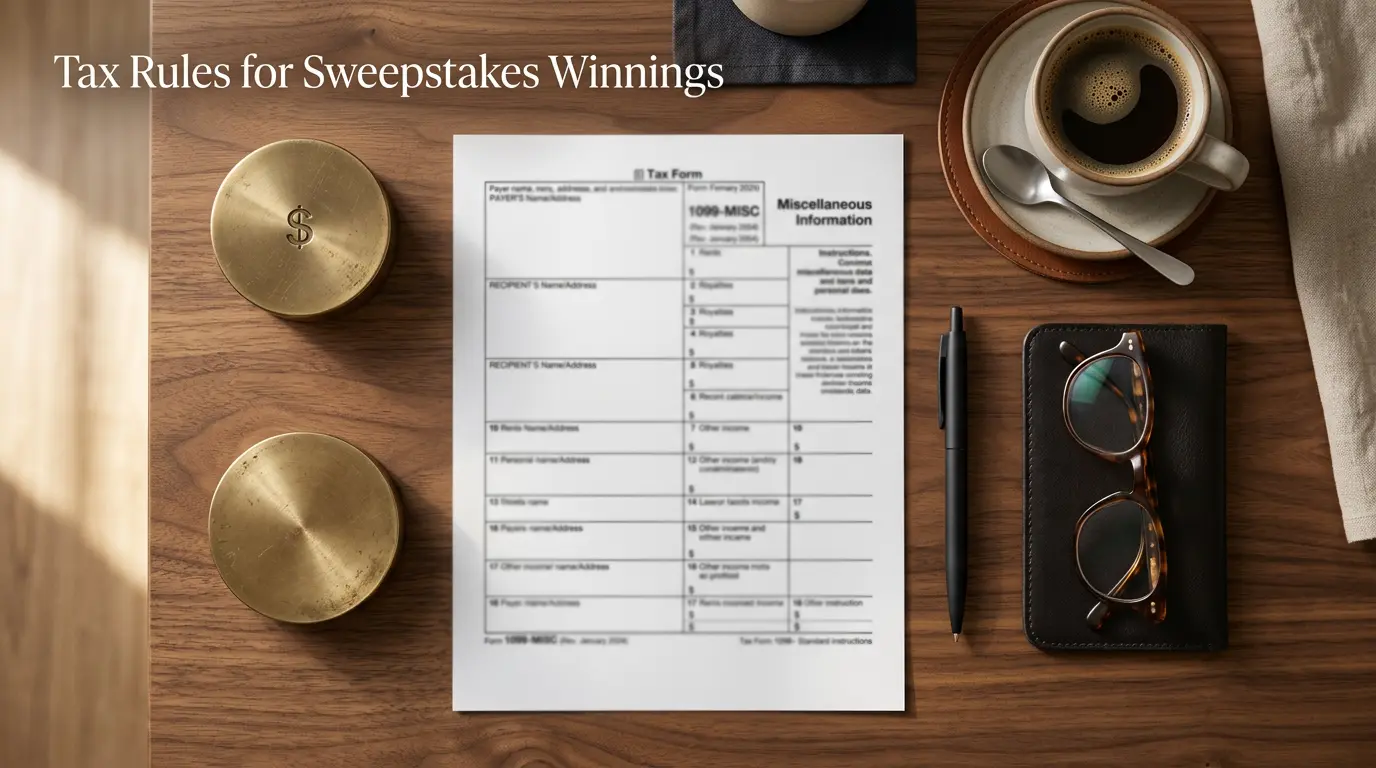
Key Sweepstakes Casino Tax Obligations & Filing Thresholds
You redeemed your sweeps coins for cash, the money hit your bank account, and now you’re wondering: does the IRS actually care about this? The short answer is yes — emphatically yes. The IRS treats your sweeps coins as income, and the rules for reporting that income are different from what most players expect.
Here’s where the confusion starts. Sweepstakes casinos aren’t classified the same way as licensed gambling operations. That distinction ripples through every tax form you’ll encounter. Instead of the familiar W-2G that a real-money casino would issue, sweepstakes platforms report your winnings on a 1099-MISC — and the reporting threshold jumped from $600 to $2,000 for the 2026 tax year under the One Big Beautiful Bill Act, a change that will affect how many players receive forms, though not whether they owe taxes.
That last part is critical: even if you never receive a 1099-MISC, you’re still legally required to report the income. This article walks through the forms, the filing steps, the state-level wrinkles, and the one deduction question everyone asks but few get right.
1099-MISC vs W-2G — Why Sweepstakes Winnings Are Reported Differently
If you’ve ever cashed out at a regulated online casino or hit a slot jackpot at a brick-and-mortar venue, the house likely handed you a W-2G. That form is designed specifically for gambling winnings — poker tournaments, slot payouts, keno, lottery prizes. It triggers when you cross certain dollar thresholds that vary by game type, and the casino withholds taxes on the spot in many cases.
Sweepstakes casinos don’t work that way. Because they operate under a sweepstakes model rather than a gambling license, the IRS doesn’t treat their payouts as “gambling winnings” in the traditional sense. Instead, redemptions land in the “Other Income” category. The form you’ll receive — if you hit the threshold — is a 1099-MISC, the same form a freelancer gets for contract work or a landlord gets for rent payments. It sounds bureaucratic, but the practical difference matters.
With a W-2G, the casino often withholds 24% of your payout before you see it. With a 1099-MISC from a sweepstakes platform, withholding isn’t automatic in most scenarios. You get the full redemption amount, and it’s on you to set aside the tax owed. That feels like a win in the moment — until April rolls around and you realize you owe the IRS a chunk of money you already spent on rent.
The 24% federal withholding does apply to individual sweepstakes payouts exceeding $5,000, as outlined in the IRS instructions for Forms W-2G and 5754. This is regular gambling withholding under IRC Section 3402(q), not backup withholding — they’re separate mechanisms. Backup withholding at the same 24% rate kicks in when you haven’t provided a valid Taxpayer Identification Number, regardless of the payout amount. So yes, that KYC verification step during account setup isn’t just about fraud prevention — it directly affects whether the operator withholds taxes from your payouts.
Jeff Duncan, Executive Director of the Social Gaming Leadership Alliance (SGLA) and former US Representative, put the industry’s position plainly at the NCLGS Winter Conference in late 2025: the sweepstakes sector wants to be regulated and wants to pay taxes. That aspiration hasn’t materialized into a standardized tax framework yet, leaving players to navigate the gap between how these platforms market themselves and how the IRS categorizes them.
One more nuance: the One Big Beautiful Bill Act raised the 1099-MISC reporting threshold from $600 to $2,000 effective for the 2026 tax year, with annual inflation adjustments starting in 2027. Fewer forms will circulate, but the IRS hasn’t raised the amount at which income becomes taxable — that’s still dollar one. You owe taxes on every cent of profit whether or not a form arrives in your mailbox.
How to Report Sweeps Coin Redemptions on Your Tax Return
The process is more straightforward than most players fear, but it does require attention to a few specific lines on your return. Here’s the sequence.
First, gather your records. Every sweepstakes casino keeps a transaction history in your account dashboard. Download or screenshot your redemption totals for the calendar year. If you received a 1099-MISC from the platform, match its figure against your own records. Discrepancies happen — sometimes a December redemption processes in January, bumping the amount into the wrong tax year.
Second, report the income on Schedule 1 (Form 1040), Line 8z, under “Other Income.” This is where non-gambling, non-employment income goes. Write a brief description — something like “sweepstakes prize winnings” — and enter the total amount. That figure then flows to Line 8 of your 1040, adding to your adjusted gross income.
Third, check whether any taxes were already withheld. If the platform withheld 24% on an individual sweepstakes payout above $5,000, that amount should appear on your 1099-MISC. You claim that withholding as a credit on your 1040 to avoid paying twice.
Fourth, run the math on what you owe. Your sweepstakes income gets taxed at your ordinary income rate, not at a special gambling rate. If your total income puts you in the 22% bracket, your sweepstakes winnings are taxed at 22%. No special treatment, no preferential rate.
A common mistake: players who receive no 1099-MISC assume they don’t need to report. With the threshold now at $2,000, it’s entirely possible to redeem $1,800 across a year without ever triggering a form. The income is still taxable. The IRS matches bank deposits against reported income — especially when those deposits come from known payment processors used by sweepstakes platforms. Underreporting isn’t a strategy; it’s a delay before a notice arrives.
State-Level Tax Obligations for Sweepstakes Winnings
Federal taxes are only half the picture. Most states with an income tax will also want their share of your sweepstakes redemptions — and the rules vary more than you’d expect.
States generally follow the federal lead: if the IRS treats it as taxable income, your state does too. But the rates, deductions, and filing requirements differ by jurisdiction. In California, for example, sweepstakes winnings are added to your state income and taxed at rates up to 13.3% for the highest earners. New York’s rate can climb to 10.9%, and that’s before New York City’s additional local tax of up to 3.876%.
A handful of states don’t tax income at all — Alaska, Florida, Nevada, New Hampshire, South Dakota, Tennessee, Texas, Washington, and Wyoming. If you live in one of those states, your federal return is the entire obligation. Ironically, several of these no-income-tax states have also moved to ban sweepstakes casinos entirely, so the tax advantage may be moot if you can’t legally play.
The tricky part is interstate play. Sweepstakes casinos are internet-based, and you might access them while traveling. Generally, you owe state tax based on your state of residence, not where you happened to be sitting when you clicked “redeem.” But if you’ve recently moved, check whether your former state has a clawback provision for income earned during residency. Some states pursue former residents for income attributable to their time in-state.
One more variable: a few states have specific gambling or prize withholding rules that might apply. Connecticut, for example, requires withholding on certain prize winnings at a flat rate. Whether those rules apply to sweepstakes casino redemptions is still gray area in many jurisdictions, which is exactly the kind of question worth raising with a tax professional who understands your state’s code.
Can You Deduct Losses From Sweepstakes Play?
This is the question that generates the most wishful thinking — and the most incorrect Reddit advice. The answer is complicated, and it doesn’t lean in the player’s favor.
Under federal tax law, gambling losses are deductible, but only up to the amount of your gambling winnings and only if you itemize deductions on Schedule A. Starting with the 2026 tax year, the One Big Beautiful Bill Act further limits the deduction to 90% of wagering losses — not the full amount. So if you won $500 and lost $800, you can deduct 90% of $500 (i.e., $450) in losses, not the full $500. You can’t use gambling losses to reduce your other income.
Here’s the catch for sweepstakes players: because the IRS classifies sweepstakes redemptions as “Other Income” rather than “Gambling Winnings,” the standard gambling loss deduction may not apply at all. The tax code’s loss deduction is specifically tied to wagering transactions under IRC Section 165(d). Whether gold coin purchases at a sweepstakes casino qualify as “wagering” is legally untested territory. The platforms themselves insist they’re not gambling — which undercuts any argument that your spending qualifies as a deductible gambling loss.
In practice, some tax preparers treat sweepstakes casino activity the same as traditional gambling for loss deduction purposes. Others take the conservative position that since the IRS receives a 1099-MISC (not a W-2G), the income and its offsetting deductions should be treated differently. Neither approach has been explicitly endorsed or rejected by the IRS in published guidance as of 2026.
What you should do: keep meticulous records regardless. Track every gold coin purchase, every sweeps coin redemption, every login bonus and AMOE credit. If the IRS ever does clarify the treatment, you’ll want documentation going back years. And if you’re dealing with amounts large enough to make the deduction question material — say, thousands of dollars in annual redemptions — this is genuinely a case where paying a CPA for an hour of their time will save you more than it costs.
This article is for informational purposes only and does not constitute tax advice. Tax laws change, individual circumstances vary, and the classification of sweepstakes casino income remains an evolving area. Consult a qualified tax professional for guidance specific to your situation.