
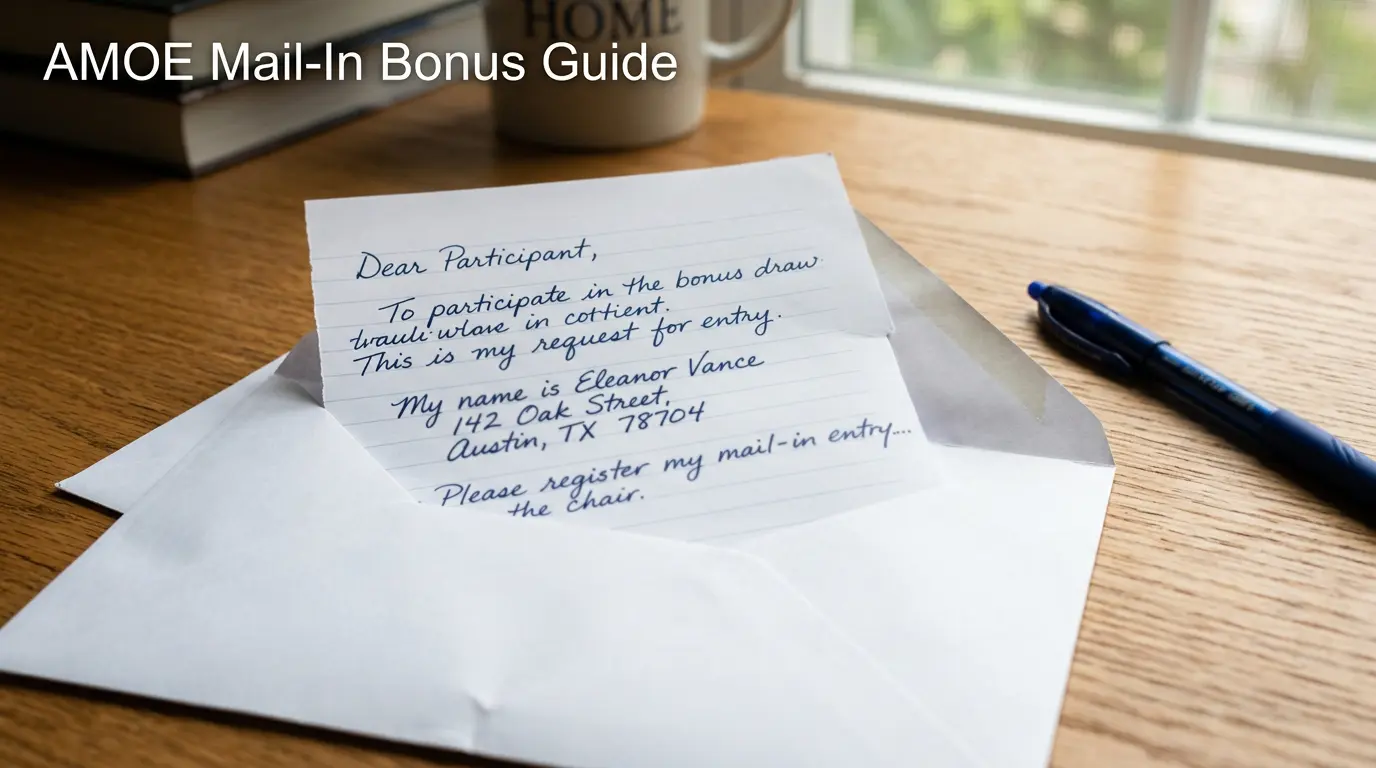
Submitting AMOE Mail-In Requests for Free Sweeps Coins
Somewhere between the flashy sign-up bonuses and the daily login wheels, there’s a method of earning free sweeps coins that most players either don’t know about or dismiss as an urban legend: the AMOE mail-in request. AMOE stands for Alternative Method of Entry, and it isn’t a loophole or a hack. Free entry is the law, not a loophole — and the entire legal structure of sweepstakes casinos depends on it.
The sweepstakes casino industry generated over $10.6 billion in gross revenue in 2024, according to a KPMG report drawing on Eilers & Krejcik Gaming data. Every dollar of that revenue flows through a legal model that requires a no-purchase-necessary path to entry. AMOE is that path. Without it, the entire sweepstakes framework collapses into unlicensed gambling — which is exactly the argument regulators in six states used to shut these platforms down in 2025.
This guide covers why AMOE exists, how to write and send a request that actually gets processed, and the platform-specific details that make the difference between free sweeps coins and a rejected envelope.
Why Every Sweepstakes Casino Must Offer a Free Entry Method
Sweepstakes law in the United States hinges on three elements: consideration (payment), chance, and prize. If all three are present, it’s gambling, and gambling requires a state license. Remove any one element and you’re operating outside the traditional gambling framework. Sweepstakes casinos remove consideration by offering a way to participate without paying — that’s the AMOE.
This isn’t a technicality buried in fine print. It’s the structural load-bearing wall of the entire business model. When players buy gold coin packages, they’re technically purchasing a virtual entertainment product. The sweeps coins included as a “free bonus” are the promotional element that can later be redeemed for prizes. But for this framing to hold up legally, there must be a way to obtain sweeps coins without buying anything at all.
The AGA’s 2025 player survey found that 69% of sweepstakes casino users consider their activity to be gambling, and 68% say their primary motivation is winning real money. That perception gap — between how the platforms classify themselves and how players experience them — is exactly why regulators scrutinize the AMOE requirement so closely. If the free entry method is buried, impractical, or functionally inaccessible, the sweepstakes defense weakens considerably.
Courts have examined this question in multiple class-action suits. The plaintiffs’ argument often centers on whether the AMOE is meaningful or merely decorative. A platform that technically offers mail-in entry but processes requests inconsistently, imposes unclear limits, or takes months to credit accounts is inviting legal challenges — and there have been over 100 class-action lawsuits filed against sweepstakes operators through late 2025.
Writing and Mailing Your AMOE Request — Step by Step
The process is deliberately old-fashioned — a handwritten letter sent via postal mail. That friction is intentional: it discourages mass abuse while still preserving the legal requirement for free entry. Here’s how to get it right.
Start with a plain piece of paper or an index card. Most platforms require your request to be handwritten, not printed. Write your full legal name exactly as it appears on your account, your registered email address, your mailing address, and a clear statement requesting free sweeps coins. Something like: “I am requesting free Sweeps Coins to be credited to my account.” Keep it simple. This isn’t an essay contest.
Place the letter in a standard #10 business envelope. Some platforms specify envelope size — check their official sweepstakes rules page before you seal it. Write the platform’s AMOE address as the recipient and your return address in the upper left corner. Use a standard first-class stamp. Certified mail or tracking is optional but useful if you want proof of delivery.
One request per envelope. This is universal across every platform. If you stuff three letters in one envelope, the entire batch gets rejected. Each envelope equals one AMOE credit. Some platforms limit you to one request per day; others allow one per stamp (effectively one per envelope per day). The limits are outlined in each platform’s official sweepstakes rules — always check there rather than relying on forum posts.
Processing time varies. Most platforms credit your account within 7 to 10 business days of receiving your letter. Some are faster; a few take up to three weeks. If the credit doesn’t appear after three weeks, follow up with customer support and reference your mailing date. Keep a simple log — date sent, platform, expected credit — to track outstanding requests.
A practical note on volume: some dedicated players send AMOE letters to multiple platforms simultaneously, stacking free SC across sites. If you play at five platforms and send one letter per week to each, that’s five envelopes, five stamps, and potentially five AMOE credits rolling in on a staggered schedule. The per-letter cost (stamp + envelope + paper) runs about $0.75, making this the cheapest possible way to accumulate sweeps coins — assuming you value your time at something close to zero.
Current AMOE Addresses and Limits by Platform
Every sweepstakes casino publishes its AMOE details in its official sweepstakes rules — usually linked from the footer of the site or the terms and conditions page. Addresses and limits change periodically, so always verify before mailing. What follows is a general overview of how the largest platforms structure their programs as of early 2026.
Most major platforms accept AMOE requests at a PO Box or physical address listed on their sweepstakes rules page. The typical credit per request ranges from 2 SC to 10 SC, depending on the platform. Some platforms tier their AMOE rewards — newer accounts or accounts with lower activity levels may receive a higher per-request allocation as a player acquisition tactic.
Daily limits are standard. The most common cap is one request per day per person, enforced by matching the name, email, and address on the letter against your account records. Platforms that allow more than one request per day are rare, and those limits can change without notice during promotional periods.
A few platforms have moved toward digital AMOE alternatives — online forms or chatbot requests that function like a mail-in but skip the postal step. These digital options aren’t available everywhere and tend to appear intermittently. When they are available, they process faster (usually within 24 to 48 hours), but the per-request credit is often lower than the physical mail option.
The critical detail: always use the address from the platform’s current, published rules page. Forum posts and third-party sites sometimes list outdated addresses, and a letter sent to an old PO Box doesn’t get forwarded. It just disappears — along with your stamp money and your patience.
Why AMOE Requests Get Rejected — and How to Avoid It
Rejected AMOE requests fall into a few predictable categories. The most common: name mismatch. If the name on your letter doesn’t match the name on your account exactly — middle initial included — some platforms will reject it outright. Use your legal name, spelled the same way you registered.
Second most common: exceeding the daily or weekly limit. If the platform allows one request per day and you send seven on Monday, six of those envelopes are dead on arrival. Space them out. One envelope, one stamp, one day.
Third: missing information. Your letter needs your name, email, mailing address, and account username (if different from your email). Omit any of these and the support team has no way to credit your account. They won’t email you for clarification — they’ll toss the request.
Fourth: illegible handwriting. The requirement to handwrite the letter exists for a reason, but if the person processing it can’t read your email address, the credit has nowhere to go. Write clearly. Print rather than cursive if your cursive looks like an EKG reading.
Finally, some players report delays that look like rejections but are actually slow processing. Before you assume the worst, give it the full processing window — typically 10 to 15 business days. If you’re tracking your letters with a log (and you should be), you’ll have the dates you need to follow up through customer support with specifics rather than vague complaints.