
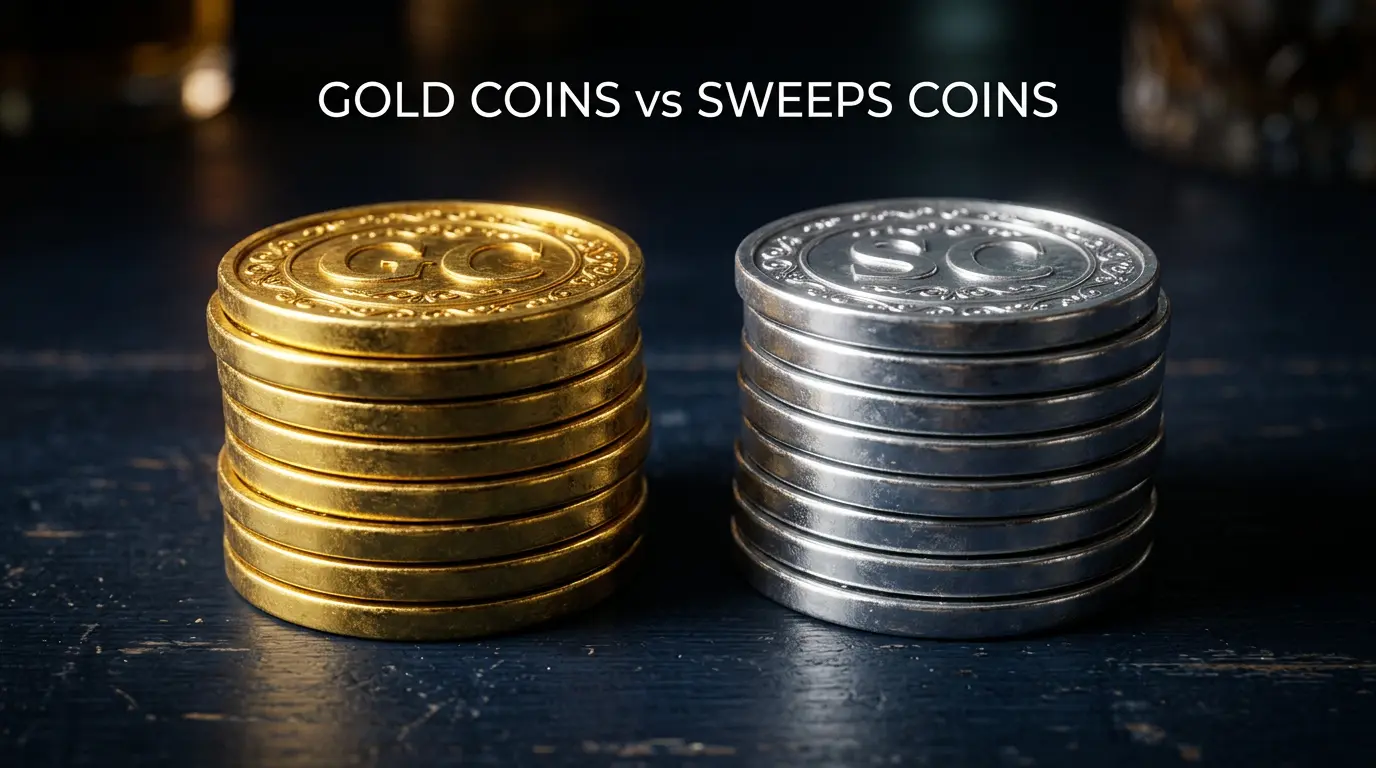
Gold Coins vs Sweeps Coins: Real Money Value & Mechanics
The first time you log into a sweepstakes casino, you’ll notice two separate balances sitting side by side. One is measured in gold coins — large, flashy numbers in the hundreds of thousands. The other is measured in sweeps coins — a much smaller figure, maybe 2 or 5 or 10. The difference between these two currencies is the difference between playing for fun and playing for cash prizes. Two currencies, one account, very different rules.
Players spent approximately $8.5 billion on gold coin packages in 2024, according to data compiled by Waterhouse VC from Eilers & Krejcik Gaming research. Yet only about 12% of users ever make a purchase. The vast majority play exclusively with free currencies — which makes understanding how each one works not just useful, but essential for anyone trying to maximize their experience without spending a dime.
Gold Coins — The Free-Play Currency You Can’t Cash Out
Gold coins are the entertainment currency. You receive them in bulk — sign-up bonuses routinely include 100,000 to 500,000 GC — and you use them to play the same games that sweeps coins unlock. The catch: gold coins have zero cash value. You can’t redeem them, convert them, or transfer them. When they’re gone, they’re gone, and the only consequence is that you need to acquire more to keep playing in GC mode.
The economic model behind gold coins is what makes the entire sweepstakes framework function. Magnus Boberg, founder of JustGamblers, explained the legal structure concisely: traditional gambling requires three elements — consideration (payment), chance, and prize. Sweepstakes sites bypass traditional gambling regulations because they separate the payment from the prize. When you buy gold coins, you’re purchasing a virtual entertainment product. The sweeps coins that come bundled with the purchase are classified as a free promotional bonus — not something you paid for.
This is why gold coin packages are priced the way they are. You’re not “depositing” money into a casino. You’re buying 200,000 gold coins for $9.99, and oh, by the way, here are 2 SC as a complimentary bonus. The gold coins are the product. The sweeps coins are the gift. Whether that distinction holds up under legal scrutiny depends on who you ask — courts across the country are actively debating it — but it’s the foundation on which every sweepstakes casino operates.
Gold coins refill through multiple channels: daily login bonuses (often 10,000 to 50,000 GC per day), social media promotions, in-game rewards, and of course, additional purchases. Because they can’t be redeemed, platforms distribute them generously. The psychological effect is intentional — a balance of 500,000 GC feels abundant, keeps you playing, and occasionally nudges you toward a gold coin purchase when the well runs dry.
Sweeps Coins — The Redeemable Currency Behind Every No-Deposit Bonus
Sweeps coins are the currency that matters. They function identically to gold coins inside the game — same bets, same slots, same odds — but they carry real-world value. Once you meet the platform’s playthrough requirement and minimum redemption threshold, SC can be converted to cash prizes, typically at a rate of 1 SC to $1 USD.
Earning sweeps coins without paying is the entire premise of the no-deposit bonus model. You receive SC through sign-up bonuses, daily logins, AMOE mail-in requests, social media giveaways, referral programs, and promotional events. The amounts are deliberately small — 0.3 SC here, 2 SC there — because each coin carries dollar-equivalent value that the platform ultimately pays out.
The playthrough requirement attached to SC is what separates sweepstakes casinos from straight-up cash giveaways. Most platforms require a 1x wagering playthrough: you must bet your SC at least once before they become redeemable. So if you received 5 SC as a sign-up bonus, you need to place 5 SC worth of bets. You might win, you might lose, but you can’t simply collect and cash out without playing.
Minimum redemption thresholds add another layer. Most platforms require you to accumulate at least 50 SC to 100 SC before you can initiate a redemption. That threshold is a critical number for free-play-only users — it determines how many login bonuses, AMOE requests, and promotional credits you need to stack before you see real money. At a daily login rate of 0.5 SC per day from a single platform, reaching 100 SC takes roughly 200 days. Stacking multiple platforms and methods accelerates the timeline considerably.
Platform-Specific Names for GC and SC
If the dual-currency system weren’t confusing enough, most platforms rename gold coins and sweeps coins to fit their branding. The underlying mechanics are identical — one currency for fun, one for cash prizes — but the labels change from site to site.
Chumba Casino uses “Gold Coins” and “Sweeps Coins” — the generic terms that became the industry standard. Stake.us calls its redeemable currency “Stake Cash” (SC) and its free-play currency “Gold Coins” (GC). Fortune Coins Casino uses “Fortune Coins” for the redeemable currency and “Gold Coins” for the play currency. WOW Vegas labels them “WOW Coins” (free-play) and “Sweepstakes Coins” (redeemable) — a more standard naming convention than some competitors, though the “WOW” branding on the free-play currency still creates occasional confusion for new players.
McLuck uses “Gold Coins” and “Sweepstakes Coins.” Crown Coins Casino brands its currencies as “Crown Coins” (free-play) and “Sweeps Coins” (redeemable). Pulsz uses “Gold Coins” and “Sweepstakes Coins.” The pattern holds across virtually every platform: one currency you can cash out, one you can’t, each with a proprietary label designed to make the platform feel distinct.
The practical advice: when evaluating any sweepstakes casino, identify which currency is redeemable before you start playing. Look for language like “redeemable for prizes,” “cash value,” or “prize redemption” in the currency description. If you can’t figure out which currency has real value within 30 seconds of reading the terms, the platform’s transparency is already a concern.
How SC Convert to Cash — Rates, Limits, and Exceptions
The standard conversion rate across the industry is 1 SC = $1 USD. This ratio holds at the vast majority of platforms, making the math simple: 50 SC in your redeemable balance equals $50 in potential cash prizes.
Some platforms deviate from the standard rate, particularly for their branded currencies. A platform that labels its redeemable currency with a proprietary name might set the conversion at 2 coins = $1, or 10 coins = $1, to make balances look larger. The effective value per coin drops, but the total dollar value of your balance stays the same. Always check the stated conversion rate in the platform’s terms before calculating the value of a bonus offer.
Conversion happens through the redemption process. You request a cash-out, the platform verifies your identity and confirms your wagering requirements are met, and the funds transfer to your bank account, PayPal, or other supported payment method. Processing times range from 24 hours to 10 business days depending on the platform, your verification status, and the payment method.
One exception worth noting: some platforms impose a maximum redemption per transaction or per day. You might have 500 SC in your balance but only be allowed to redeem 100 SC per day or 200 SC per transaction. This cap varies by platform and sometimes by your VIP tier or verification level. High-volume redeemers may need to split their cashouts across multiple days or request a limit increase through customer support.