Enforcement and Impact of the New York S 5935 Casino Ban
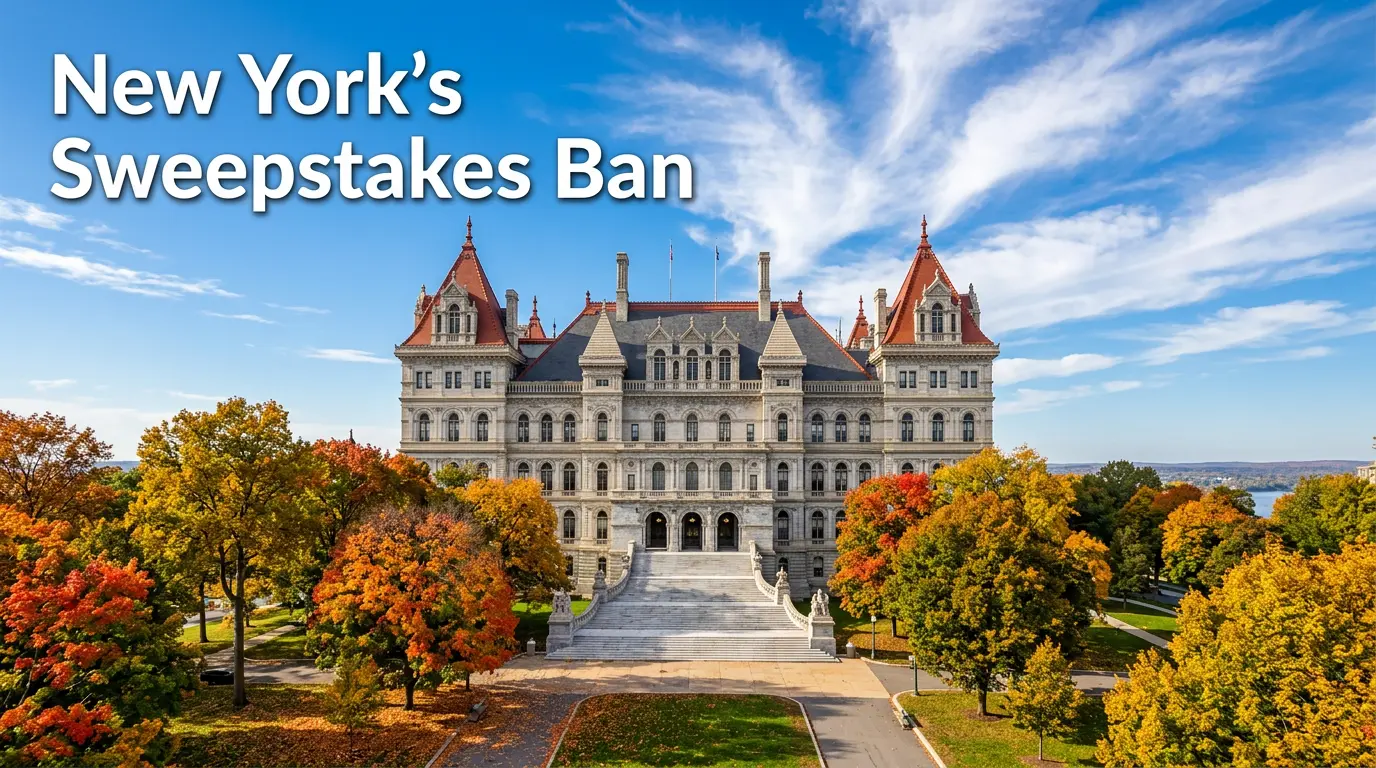
New York was the second-largest state market for sweepstakes casinos, generating an estimated $762 million in annual sales according to data compiled by Eilers & Krejcik Gaming for the Social Gaming Leadership Alliance. When Governor Kathy Hochul signed S 5935 into law on December 5, 2025 — with the ban taking effect immediately — that revenue stream was severed, and the implications extended far beyond the state’s borders. $762 million gone — New York’s sweepstakes shutdown sent a signal to every state considering similar action.
New York’s ban was part of the broader wave of six state-level prohibitions enacted in 2025, but it carried unique weight because of the state’s mature gambling infrastructure, its large and digitally active population, and the political dynamics that accelerated the legislation through the Senate.
S 5935 — What the New York Law Covers
Senate Bill 5935 targeted sweepstakes casinos by amending New York’s gambling statutes to encompass the dual-currency model. The law classified the sale of virtual currency packages containing redeemable tokens as a form of gambling, nullifying the sweepstakes defense that operators relied on nationally.
New York was among six states to ban sweepstakes casinos in 2025. The legislation passed with broad bipartisan support, driven by a coalition of commercial casino operators (who were building physical and online gaming operations in the state), existing gaming commission officials (who saw sweepstakes casinos as an enforcement gap), and consumer protection advocates (who argued that unregulated gaming exposed vulnerable players to harm).
The law’s scope covers any entity that offers virtual currency for purchase where an associated promotional currency can be redeemed for prizes with real-world value. This definition was crafted to capture the specific mechanics of sweepstakes casinos without inadvertently prohibiting other types of promotional sweepstakes (grocery store drawings, charity raffles, etc.) that operate under different structures.
Enforcement falls under the New York State Gaming Commission and the Attorney General’s office. Penalties include fines between $10,000 and $100,000 per violation, potential loss of any existing gaming license or future eligibility, and injunctive orders to cease operations. Unlike California’s ban, which included a transition period before its January 1, 2026 effective date, New York’s law took effect immediately upon Hochul’s signature — leaving operators no formal wind-down period. The enforcement framework is more formalized than in some other ban states, reflecting New York’s existing regulatory infrastructure for gambling oversight. The Gaming Commission already monitors licensed online sports betting operators — extending that oversight to sweepstakes enforcement was a natural expansion of existing capabilities rather than a new bureaucratic creation.
The compliance timeline was compressed by prior enforcement actions. Before the bill was even signed, Attorney General Letitia James had sent cease-and-desist orders to 26 sweepstakes platforms, all of which complied. Major platforms had already exited or restricted New York access months before Hochul’s signature, making the formal ban a codification of an already-shrinking market rather than a sudden shutdown.
The political dynamics that drove S 5935 are worth understanding because they’re likely to repeat in other states. New York’s licensed gambling industry — including commercial casinos expanding into the downstate market and a thriving online sports betting sector — saw sweepstakes casinos as a direct competitor operating without the licensing fees, tax obligations, or regulatory overhead they bore. The argument was straightforward: if we pay to play by the rules, everyone else should too. That framing resonated across party lines and accelerated the bill’s passage.
Financial Fallout for Operators and Players
Losing New York’s $762 million market compounded the damage already inflicted by California’s ban. Together, the two states represented approximately 30% of the sweepstakes casino industry’s total revenue. Eilers & Krejcik Gaming’s revised 2026 forecast — a projected 10% decline in net revenue to $3.6 billion under the base case — incorporated the combined impact of all six state bans, with California and New York contributing the lion’s share.
For operators, the New York ban created a particular challenge: many had invested in marketing campaigns targeting the state’s dense, digitally connected population. Those acquisition costs — spent on players who could no longer be served — became sunk costs with no recovery path. Some operators had accumulated significant player bases in New York over years of operation, and losing those accounts meant losing both current revenue and the lifetime value of each player.
For New York players, the ban was abrupt. Accounts were frozen, access was blocked, and any SC balance that wasn’t redeemed within the compliance window was at risk. Players who had been building their balances through months of daily logins and AMOE requests found their accumulation rendered inaccessible overnight. The experience underscored a risk inherent in sweepstakes casino play: platform access depends entirely on a legal framework that can change without notice.
The secondary effect on the broader industry was psychological as much as financial. New York’s action — combined with California’s nearly simultaneous ban — demonstrated that even the largest, most politically influential states were willing to act against sweepstakes casinos. For legislators in smaller states considering similar measures, the message was clear: if California and New York can ban sweepstakes casinos without meaningful political fallout, so can we.
Legal Alternatives for New York Residents
New York residents have more legal gambling options than most Americans, even without sweepstakes casinos. The state operates one of the most active online sports betting markets in the country, with licensed operators offering mobile wagering statewide since 2022. Multiple commercial casinos and tribal gaming facilities operate physical locations across the state, and the New York Lottery offers both retail and online ticket purchases for select games.
Online casino gaming (iGaming) is the notable gap. As of early 2026, New York has not legalized online casino play, despite persistent legislative efforts. If and when iGaming passes — a prospect that industry observers consider likely within the next few years — it would fill the market space vacated by sweepstakes casinos with a regulated alternative offering consumer protections, responsible gaming mandates, and tax contributions that the sweepstakes model never provided.
For New York players who specifically valued the free-play aspect of sweepstakes casinos — the no-deposit bonuses, the daily logins, the zero-cost entry — no current legal alternative replicates that experience. Free-to-play social casino apps (which don’t offer real-money redemption) provide entertainment without financial stakes, but they lack the redemption pathway that made sweepstakes casinos appealing.
The free-play audience that sweepstakes casinos cultivated in New York remains underserved, waiting for either a new legal model or a shift in the state’s regulatory approach. In the meantime, the licensed alternatives offer a different kind of gaming experience — one with consumer protections, regulatory oversight, and tax contributions, but without the something-for-nothing appeal that drew millions of Americans to sweepstakes platforms in the first place.