Consequences of the Google Sweepstakes Casino Advertising Ban
Google didn’t warn the industry. On October 28, 2025, the company updated its advertising policies to remove sweepstakes casinos from the “social casino games” category that had previously allowed their ads across Google Search, YouTube, and the Display Network. The biggest traffic shakeup in sweepstakes history hit without a transition period, without a grandfather clause, and without an alternative compliance pathway. Ads stopped running. Traffic dropped overnight.
For an industry that had built its customer acquisition strategy around paid digital advertising — with Google as the primary channel — the ban was a structural shock, not just a budget inconvenience. The ripple effects touched every operator’s marketing plan, every affiliate’s revenue model, and every player’s path to discovering new platforms and bonus offers.
What Google’s New Policy Actually Says
Google’s advertising policies distinguish between categories of gaming content. Licensed online casinos can advertise in jurisdictions where they hold valid licenses. Social casino games — apps that simulate gambling without real-money outcomes — can advertise broadly. Until October 2025, sweepstakes casinos were classified alongside social casino games, allowing them to run ads nationally without a gambling license.
The policy update reclassified sweepstakes casinos as a distinct category excluded from the social casino exemption. Google’s rationale, while not elaborated in detail publicly, aligned with the growing regulatory consensus that sweepstakes casinos function as gambling in practice regardless of their legal framing. The wave of over 100 class-action lawsuits, six state bans, and public pressure from the AGA likely influenced the timing.
Baltimore Mayor Brandon Scott, whose city filed suit against six sweepstakes operators in March 2026, captured the sentiment driving regulatory and platform actions: these companies target communities and profit while ignoring the law. Google’s decision can be read as a corporate risk mitigation — removing sweepstakes casino ads before regulators or courts forced the issue and potentially exposed Google to liability for facilitating advertising of unlicensed gambling.
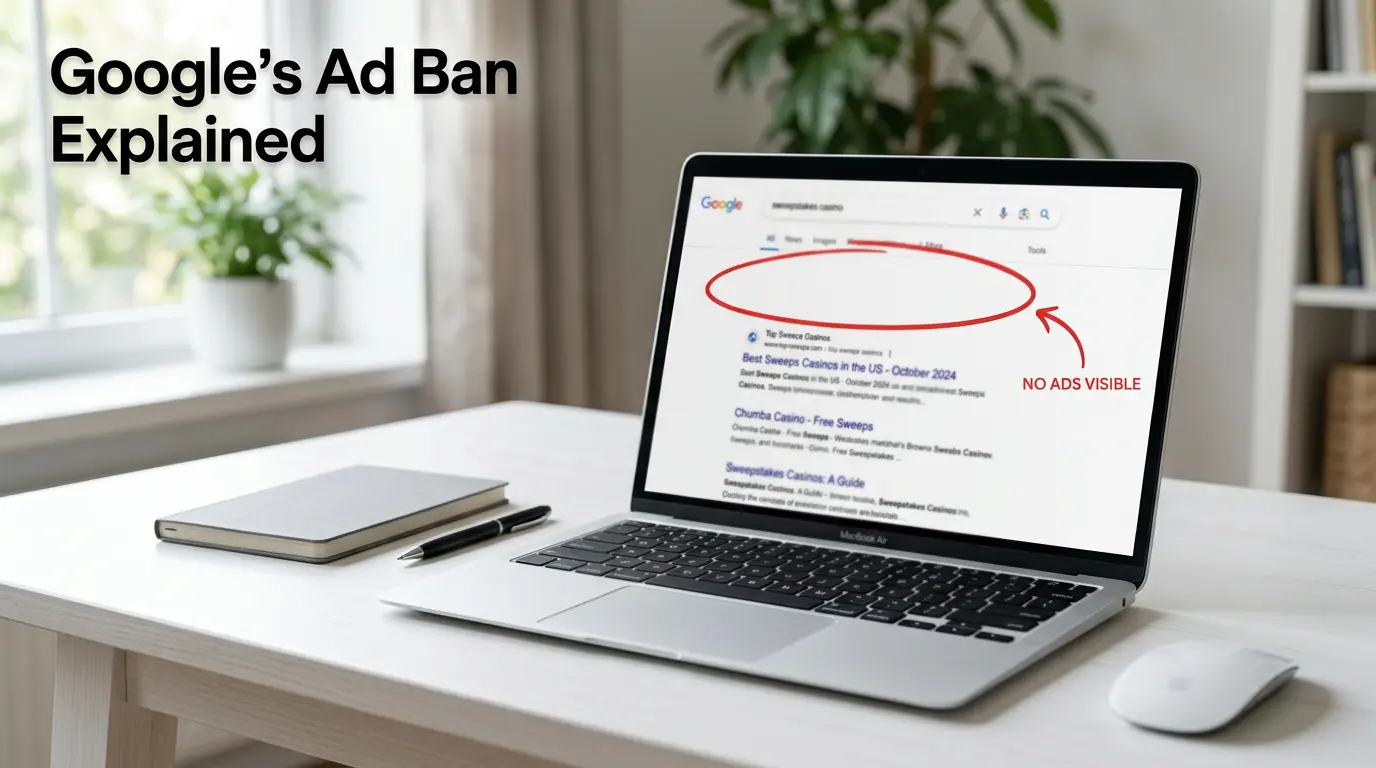
The ban covers all Google advertising products: Search Ads, Display Network, YouTube pre-roll and mid-roll ads, Discovery Ads, and Shopping Ads. Sweepstakes casino websites still appear in organic search results — the ban targets paid placements only. Organic search rankings, Google Play Store listings, and Google Maps entries (where applicable) were unaffected by the advertising policy change.
One nuance worth noting: the policy doesn’t explicitly ban advertising by all sweepstakes-related businesses. Affiliate sites, review platforms, and bonus comparison tools that write about sweepstakes casinos — but don’t operate them — can still advertise on Google, subject to standard content policies. The ban targets operator ads, not the broader ecosystem of content about sweepstakes casinos.
How the Ban Reshaped Operator Traffic
The traffic impact was immediate and severe for operators whose acquisition strategy depended heavily on Google Ads. Before the ban, sweepstakes casinos accounted for roughly 50% of all online casino advertising seen by US consumers, according to AGA data analyzed by Sensor Tower. The majority of that volume ran through Google’s platforms. Removing that channel didn’t just reduce traffic — it eliminated the most scalable, most targetable, and most measurable acquisition tool available to operators.
Operators responded by redirecting budgets to alternative channels. Social media advertising on Meta (Facebook, Instagram) and TikTok absorbed the largest share of redirected spend. Affiliate marketing — already a significant channel — became even more critical as operators increased commission rates to incentivize review sites and content creators to drive registrations. Email marketing, SMS campaigns, and direct-to-consumer outreach through owned channels gained renewed attention.
The shift had a sorting effect on the market. Large operators with diversified marketing strategies — television, celebrity partnerships, social media, affiliates — absorbed the Google ban without existential consequences. Their brand recognition carried traffic regardless of the advertising channel. Smaller operators that had bootstrapped their growth through Google Ads faced an acquisition crisis. Without the paid search funnel, their primary mechanism for reaching new players disappeared, and alternatives required both larger budgets and longer lead times to produce comparable results.
The organic search landscape also shifted subtly. With paid ads removed from the top of search results, the first page of Google for queries like “sweepstakes casino bonus” became entirely organic. Review sites, affiliate platforms, and informational content moved up the page, gaining visibility they had previously shared with (or lost to) paid placements. For operators with strong SEO programs, the ban was paradoxically beneficial — their organic listings gained prominence in a less cluttered search environment. For operators that had neglected organic content in favor of paid acquisition, the ban exposed a vulnerability that couldn’t be patched overnight.
Finding Bonuses After the Ad Ban
For players, the Google ad ban changed how you discover sweepstakes casinos and evaluate their offers. The sponsored links that previously appeared at the top of search results — often highlighting specific bonus amounts and promo codes — are gone. What remains is a mix of organic results that includes operator websites, review sites, community forums, and informational articles.
The practical advice: rely on multiple sources rather than clicking the first result. Review sites that disclose affiliate relationships, community forums where real players share their experiences (Reddit’s r/SweepstakesSideHustle, for example), and operator social media accounts are the most reliable channels for current bonus information. Cross-reference any offer you find against the platform’s official terms before signing up.
The disappearance of Google Ads also means fewer scam ads. Before the ban, bad actors occasionally ran paid ads mimicking legitimate sweepstakes casinos, directing clicks to phishing sites or fraudulent platforms. Google’s ad review process caught most of these, but some slipped through. Without sweepstakes casino ads in the ecosystem at all, that particular vector is closed — a modest but genuine improvement in player safety that arrived as an unintended side effect of a policy driven by entirely different concerns.
Long-term, the Google ban may accelerate the consolidation of player attention around a smaller number of well-known platforms. Without the paid advertising that helped newer operators compete for visibility, brand recognition becomes the dominant factor in player acquisition. Players who already know Chumba, Stake.us, or McLuck by name will continue finding them through direct navigation and organic search. Players who would have discovered a newer platform through a Google Ad may never encounter it at all. The biggest traffic shakeup in sweepstakes history didn’t just change how platforms advertise — it changed which platforms players are likely to find.